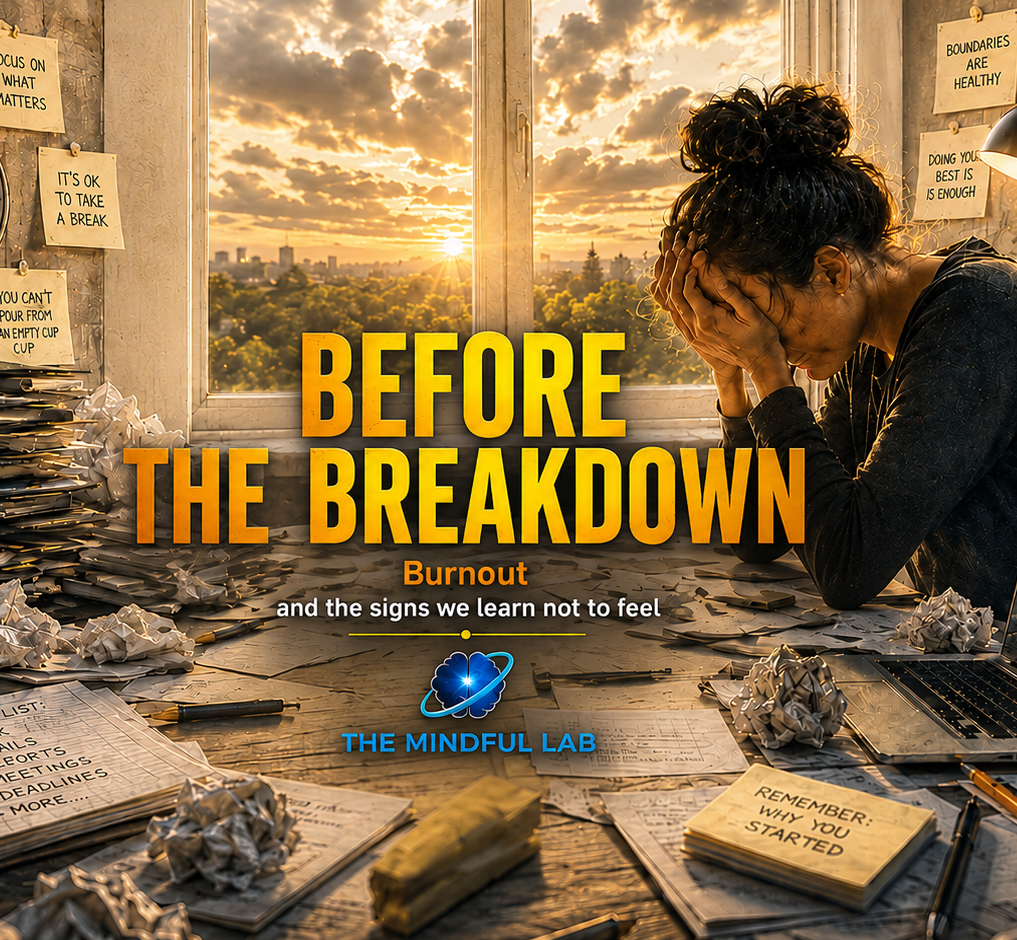
THE RELIEF THAT COMES AT A COST – Anxiety, Emotions, and the Neuroscience of Procrastination
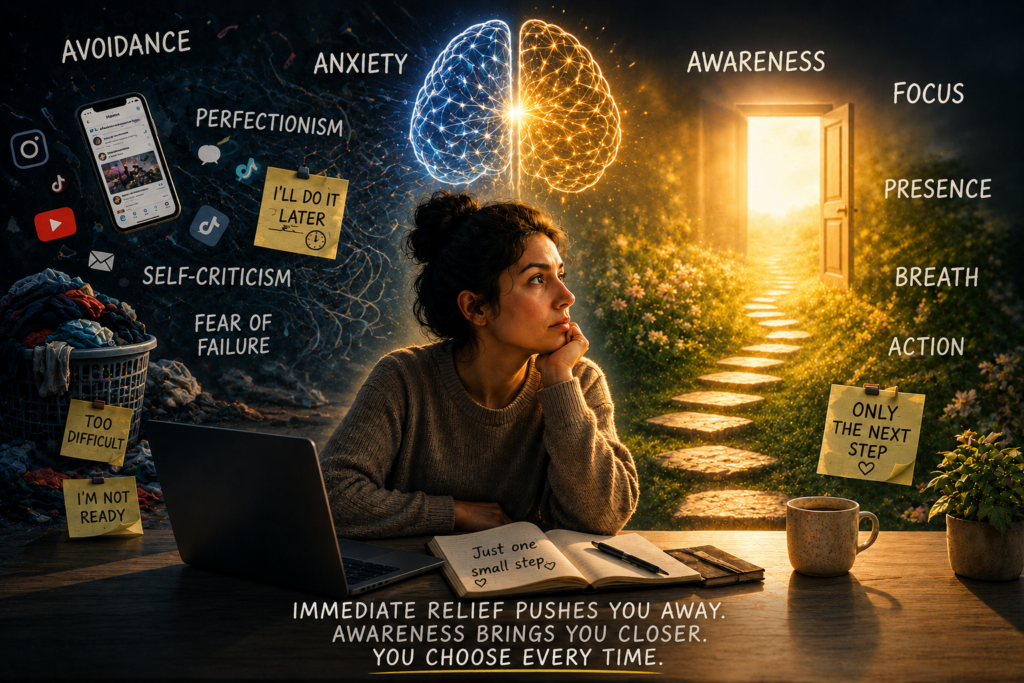
We put things off to feel better.
And almost always, we end up feeling worse.
We know that the phone call will eventually have to be made, that the unfinished work will become more urgent, and that a decision cannot be avoided forever.
And yet, we do not begin.
We check our phones, organise something less important, search for more information, or wait until we feel more focused, more confident, or more motivated.
We tell ourselves:
“I’ll do it later.”
“Tomorrow my mind will be clearer.”
“First, I need to understand where to begin.”
But often, the problem is not that we do not know what to do.
The problem is what we feel when we think about doing it.
Procrastination is not simply poor time management. It can be an attempt to escape, at least temporarily, from anxiety, boredom, uncertainty, fear of failure, or the feeling of not being good enough.
The relief we obtain by postponing, however, comes at a cost: the task remains, time runs out, and the discomfort tends to increase.
The Relief That Comes at a Cost – What Is Procrastination, Really?
Procrastinating does not simply mean postponing something.
There are reasonable reasons for delaying an activity. We may decide to postpone it because we lack important information, because another priority is more urgent, or because we are genuinely tired and need to recover.
Procrastination occurs when we delay an important action even though we know that doing so may harm us.
It therefore creates a gap between:
- what we intend to do;
- what we are actually able to begin;
- what we choose in order to obtain immediate relief.
A seminal meta-analysis by Piers Steel described procrastination as a complex form of self-regulation failure, associated particularly with impulsivity, task aversiveness, and difficulty assigning sufficient value to future consequences.
This does not mean that every delay is pathological or that procrastination is, in itself, a diagnosis.
It may occur occasionally or become a persistent habit. It can also appear alongside anxiety, stress, depression, perfectionism, attentional difficulties, sleep disruption, or ADHD.
The Relief That Comes at a Cost – We Are Not Only Avoiding the Task
Very often, we are not avoiding what we need to do.
We are avoiding the emotional experience associated with doing it.
A task may evoke:
- fear of making mistakes;
- fear of being judged;
- feelings of inadequacy;
- confusion;
- boredom;
- frustration;
- pressure;
- uncertainty;
- overwhelm.
When we imagine carrying out an activity, the brain does not only assess the actions required to complete it.
It also anticipates what we might feel while doing it.
When that experience is perceived as unpleasant or threatening, the impulse to move away becomes stronger.
We pick up our phones, switch to another activity, or convince ourselves that we will start at a better time.
The tension decreases.
And it is precisely this temporary reduction in tension that reinforces the behaviour.
The brain may learn:
“When this task makes me feel bad, moving away from it brings relief.”
Procrastination therefore becomes a short-term emotional regulation strategy.
It does not solve the problem, but it temporarily interrupts our contact with discomfort.
The Cycle Between Anxiety and Procrastination
Anxiety can play a central role in procrastination.
An activity that has not yet been started contains many possibilities:
we may succeed, fail, be judged, be rejected, or discover that we are not sufficiently prepared.
For an anxious mind, uncertainty may be perceived as a threat.
As long as we do not act, the outcome remains suspended.
If we do not submit the project, we will not yet know whether it will be rejected.
If we do not make the phone call, we will not yet have to face the response.
If we do not make a decision, no possibility will be permanently excluded.
Postponing may therefore seem like a way to keep the future open.
But the future we are trying to push away remains constantly present in the mind.
The task:
- continues to occupy mental space;
- returns while we are doing something else;
- generates repetitive thoughts;
- fuels guilt and self-criticism;
- becomes increasingly urgent as time passes.
A cycle is created:
task perceived as threatening → anticipatory anxiety → avoidance → immediate relief → increased pressure → self-criticism → renewed anxiety → further avoidance
A 2025 systematic review and meta-analysis, based on 88 studies and more than 63,000 participants, found a moderate positive association between procrastination and negative emotions, particularly anxiety, stress, and depressive symptoms.
The authors also highlighted the potentially bidirectional nature of this relationship: emotional distress may contribute to procrastination, while procrastination may, in turn, intensify emotional distress.
The Relief That Comes at a Cost – When Perfectionism Prevents Us from Beginning
Not everyone who procrastinates is uninterested.
Some people deeply want to do well.
So well that they cannot begin.
When our internal standards are unrealistic, every first attempt appears inadequate.
We do not allow ourselves to:
- write an imperfect first draft;
- learn as we proceed;
- continue without already knowing all the answers;
- make mistakes;
- expose ourselves to judgement.
The task is no longer simply something to complete.
It becomes a test of our personal worth.
I am not merely preparing a project: I am trying to prove that I am intelligent, competent, and deserving of approval.
In this context, procrastination may temporarily protect self-esteem.
If I complete everything at the last minute and the result is disappointing, I can attribute the failure to a lack of time rather than to my abilities.
This protection, however, creates another cost: shame, self-criticism, and a loss of confidence in ourselves.
WATCH THE VIDEO – English Subtitles Available – Activate CC.
In this video from THE MINDFUL LAB, we explore the connection between procrastination, anxiety, emotional regulation, and mindfulness, discovering why immediate relief can gradually become a trap.
The Relief That Comes at a Cost – The Present Receives the Relief, the Future Receives the Bill
Anxiety does not explain every form of procrastination.
We may also delay because:
- an activity is boring;
- the task is poorly defined;
- it involves too many decisions;
- we are tired or overwhelmed;
- the reward feels too distant;
- an immediately gratifying alternative is available.
A phone can provide a reward within seconds.
Studying, working, exercising, or facing a difficult conversation require immediate effort in exchange for a future benefit.
The present speaks loudly.
The future whispers.
When we are stressed or emotionally overwhelmed, that whisper becomes even harder to hear.
When we say, “I’ll deal with it tomorrow,” we often imagine a future version of ourselves who is more energetic, more focused, and less afraid.
But the person who will face that task tomorrow will still be us.
With the same vulnerability and less time.
If you find this content useful, you can support it with a free donation. 🙏
The Relief That Comes at a Cost – When Procrastination Looks Like Distraction
Procrastination can also appear through attentional difficulties.
We open a document and, moments later, check a message.
We read a page without remembering it.
We constantly switch from one activity to another.
This does not automatically mean that we have an attention disorder.
Concentration can be disrupted by:
- anxiety;
- worry;
- stress;
- tiredness;
- sleep deprivation;
- low mood;
- digital overstimulation.
In other cases, more persistent difficulties involving executive functions may be present: beginning an activity, planning the necessary steps, estimating time, keeping a goal active in the mind, and resisting distractions.
These difficulties may occur in ADHD, but they are not sufficient, on their own, to establish a diagnosis.
Interpreting every distraction as ADHD risks trivialising a complex clinical condition.
However, attributing every difficulty to laziness can make people who are genuinely struggling with attention and executive functioning feel unnecessarily guilty.
Even Being “Busy” Can Become a Form of Avoidance
Procrastination does not always look like inactivity.
Sometimes we are extremely busy, but we are not moving any closer to what truly matters.
We reply to non-urgent messages.
We organise files.
We revise the same detail for the tenth time.
We create elaborate plans.
We continue gathering information without ever beginning.
These activities may make us feel productive, but they may also protect us from the action that exposes us most deeply.
Not all productivity is movement towards what matters.
Sometimes it is a sophisticated form of avoidance.
Why Self-Criticism Makes the Problem Worse
After procrastinating, many people try to correct themselves through inner aggression:
“You’re lazy.”
“You never finish anything.”
“You have no discipline.”
“You’ve failed again.”
Self-criticism may seem like a way to force ourselves into action, but it often has the opposite effect.
It increases stress, turns the task into another opportunity for judgement, and makes returning to it even more painful.
The person no longer has to face only the activity itself.
They must also face everything they have begun to believe about themselves.
Shame intensifies the desire to move away.
And moving away produces more shame.
Treating ourselves with kindness does not mean justifying every delay.
It means not adding further suffering to an already difficult experience.
Anxiety, Emotions, and the Neuroscience of Procrastination – How Can Mindfulness Help?
Mindfulness does not promise to eliminate anxiety, boredom, or resistance forever.
It can, however, teach us not to allow every emotion to become an automatic command.
The process usually happens very quickly:
I feel discomfort → I seek a distraction → I move away
Mindfulness introduces a space between these steps.
We can recognise:
“There is anxiety.”
“There is confusion.”
“There is fear of failure.”
“There is an impulse to pick up my phone.”
This observation is very different from thinking:
“I am incapable.”
“I am not ready.”
“I have to wait until this feeling disappears.”
An emotion is a present experience, not necessarily an accurate prediction of the future.
Tension does not prove that we will fail.
Fear does not prove that we are not ready.
The impulse to avoid does not oblige us to obey it.
A specific meta-analysis found an inverse relationship between dispositional mindfulness and procrastination: higher levels of mindfulness were associated with a lower tendency to delay tasks.
However, the authors also emphasised the need for further experimental research to determine the extent to which mindfulness-based interventions can directly produce this change.
Four Steps to Interrupt the Automatic Pattern
1. Recognise the Emotion
Before asking ourselves:
“How can I force myself to begin?”
we can ask:
“What am I trying not to feel?”
A specific fear may emerge, or perhaps only a physical sensation: tightness, heaviness, restlessness, or emptiness.
We can locate it in the body and remain with it for a few breaths.
Not in order to eliminate it.
But to avoid immediately turning it into an escape response.
2. Separate Thought from Reality
An anxious mind may produce thoughts such as:
“It is too difficult.”
“I will never be able to finish it.”
“If it is not perfect, it will be a disaster.”
We can recognise:
“I am having the thought that it is too difficult.”
“I am imagining failure.”
“I am judging the place from which I am beginning.”
The thought is not suppressed.
But it no longer occupies the entire field of awareness.
3. Reduce the Horizon
The procrastinating mind often sees the entire task all at once.
It does not see one page: it sees the whole book.
It does not see one phone call: it sees every possible consequence.
Mindfulness brings attention back to the only action that can actually be performed: the present one.
Not:
“I have to finish everything.”
But:
“What is the smallest action I can take right now?”
Open the document.
Write the title.
Find the number you need to call.
Stay with the task for five minutes.
The first goal is not to finish.
It is to come into contact with the action without immediately running away.
4. Distinguish Rest from Avoidance
Taking action does not mean ignoring our limits.
We may genuinely be tired or need support.
Mindfulness should not become another instrument of self-imposition.
It can also help us distinguish between:
“Am I avoiding an emotion?”
and:
“Does my body genuinely need to stop?”
Sometimes the most conscious action is to begin.
At other times, it is to rest intentionally, deciding when and how we will return to the task.
Chosen rest is different from automatic escape.
A Short Practice for the Moment You Notice You Are Procrastinating
When you realise that you are avoiding an activity:
- place your feet firmly on the ground;
- bring your attention to your body;
- acknowledge what you are feeling;
- notice the impulse to move away;
- ask yourself: “What am I afraid might happen if I begin?”;
- listen to the answer without judging it;
- identify the smallest possible action you can take within the next five minutes.
During those five minutes, notice each time the mind begins searching for an escape route.
Do not criticise it.
Bring your attention back to the action, just as you return your attention to the breath during meditation.
Every return is part of the training.
The goal is not to become a productivity machine.
It is to regain freedom at the point where, previously, there was only automatic behaviour.
Can Mindfulness Heal Procrastination?
It is important to use the word “healing” with caution.
Research suggests that mindfulness meditation programmes may produce moderate improvements in some symptoms of anxiety, depression, and stress, but the effects vary between individuals, populations, and types of intervention.
The evidence specifically relating to procrastination is promising, but remains more limited.
We can say that mindfulness may help us work with some of the processes that maintain procrastination:
- automatic reactions to discomfort;
- identification with thoughts;
- impulsivity;
- difficulty returning attention to the task;
- intolerance of unpleasant emotions;
- self-criticism;
- anxiety and stress.
We cannot claim that mindfulness alone guarantees the disappearance of every form of procrastination.
When procrastination is severe, persistent, or connected to clinical anxiety, depression, ADHD, or other difficulties, seeking support from a qualified professional may be helpful.
A systematic review of psychological interventions found overall benefits that were small but statistically significant.
In the limited number of studies focusing on cognitive behavioural therapy, the effects were moderate, although the quantity and quality of the available evidence still require cautious interpretation.
A New Relationship with Action
Perhaps we will never completely stop experiencing resistance.
Some tasks will continue to intimidate us.
Transformation does not mean always feeling motivated.
It means recognising the moment when the mind seeks relief through escape and discovering that we can choose differently.
Not through force.
Not through shame.
But through a presence steady enough to tell us:
“I can feel this tension and still take one small step.”
Because the opposite of procrastination is not relentless productivity.
It is the ability to remain present in front of what matters.
Even when we do not yet feel completely ready.
FAQ – Frequently Asked Questions
Is procrastination caused by anxiety?
Not always, but anxiety can be one of its main drivers. A person may postpone an activity in order to temporarily avoid fear, uncertainty, pressure, or concern about being judged.
However, procrastination may also be connected to boredom, tiredness, perfectionism, attentional difficulties, and the search for immediate gratification.
Does procrastinating mean being lazy?
No. Laziness generally implies little intention or desire to act.
People who procrastinate often genuinely want to complete the task, but struggle to tolerate the emotions or effort associated with beginning.
Can mindfulness help with procrastination?
Mindfulness may help us recognise the impulse to avoid, observe anxiety and thoughts without reacting automatically, bring attention back to the present action, and reduce self-criticism.
Direct evidence regarding procrastination is promising, but still limited.
Does procrastinating mean that I have ADHD?
No. Procrastination is extremely common among people who do not have ADHD.
In attention deficit hyperactivity disorder, it may be associated with more persistent difficulties in beginning tasks, managing time, and using executive functions.
However, only a professional assessment can establish a diagnosis.
How can I begin a task that I keep postponing?
It may help to identify the emotion you are trying to avoid and reduce the task to the smallest concrete action possible: opening the document, writing one sentence, preparing the necessary materials, or working for five minutes.
This is THE MINDFUL LAB
A space where Mindfulness, Neuroscience, Spirituality, and Human Experience come together to promote self-knowledge and personal growth.
If you found this article helpful, leave a like, share it with someone you care about, subscribe to our newsletter, and explore our YouTube channel.

Suggested Internal Links — THE MINDFUL LAB
- WHY ANXIETY FEELS SO REAL: When the Future Invades the Present
- Are You Loving the Other Person or Your Story? The Neuroscience of Projection and Expectations
- What Kind of Relationships Are You Really Living? The Neuroscience of Human Connection and Co-Regulation
- Are You Really Overreacting? The Neuroscience of Stress, Trauma and the Nervous System
- WHY CHRONIC STRESS CAN LEAD TO INFLAMMATION: The Neuroscience of Persistent Threat
- STRESS AND THE IMMUNE SYSTEM: What Happens in the Body When You Live in a Constant State of Alert
- WHERE STRESS COMES FROM: The Real Reasons Behind Your Discomfort
- ARE YOU LIVING ON AUTOPILOT? Why It Happens and How to Break Free
- WHY DO YOU KEEP THINKING ABOUT THE PAST?
- HOW TO CALM YOUR MIND WHEN IT WON’T STOP: Understanding the Busy Mind
- WHY THE MIND NEVER STOPS THINKING: Neuroscience Explains It
SCIENTIFIC SOURCES AND REFERENCES
Definition, Prevalence, and General Mechanisms of Procrastination
- Steel, P. (2007) – The Nature of Procrastination: A Meta-Analytic and Theoretical Review of Quintessential Self-Regulatory Failure
- Rozental, A. et al. (2022) – Procrastination Among University Students: Differentiating Severe Cases in Need of Support From Less Severe Cases
- Sirois, F. M. & Pychyl, T. A. (2013) – Procrastination and the Priority of Short-Term Mood Regulation: Consequences for Future Self
- Wypych, M. et al. (2018) – Roles of Impulsivity, Motivation and Emotion Regulation in Procrastination
- Schuenemann, L. et al. (2022) – “I’ll Worry About It Tomorrow”: Fostering Emotion Regulation Skills to Overcome Procrastination
Procrastination, Anxiety, Depression, and Stress
- Jochmann, A. et al. (2024) – Procrastination, Depression and Anxiety Symptoms in University Students: A Three-Wave Longitudinal Study
- Nie, Y. et al. (2025) – The Association Between Procrastination and Negative Emotions: A Systematic Review and Meta-Analysis
- Johansson, F. et al. (2023) – Associations Between Procrastination and Subsequent Health Outcomes Among University Students in Sweden
Perfectionism, Fear of Failure, and Self-Criticism
- Cho, M. & Lee, Y. S. (2022) – The Effects of Medical Students’ Self-Oriented Perfectionism on Academic Procrastination: The Mediating Effect of Fear of Failure
- Zhang, Y. et al. (2018) – Self-Efficacy for Self-Regulation and Fear of Failure as Mediators Between Self-Esteem and Academic Procrastination
- Rehman, S. et al. (2023) – Self-Compassion and Bedtime Procrastination: The Mediating Role of Emotion Regulation
Immediate Reward, Time, and the Representation of the Future
- Wu, H. et al. (2016) – The Procrastinators Want It Now: Behavioral and Event-Related Potential Evidence of Greater Delay Discounting
- Rebetez, M. M. L. et al. (2016) – Procrastination, Consideration of Future Consequences and Episodic Future Thinking
- Zhang, S. et al. (2019) – To Do It Now or Later: The Cognitive Mechanisms and Neural Substrates Underlying Procrastination
Executive Functions, Attention, and Procrastination
- Rinaldi, A. R. et al. (2021) – Procrastination as Evidence of Executive Functioning Impairment in College Students
- Bolden, J. & Fillauer, J. P. (2019) – “Tomorrow Is the Busiest Day of the Week”: Executive Functions Mediate the Relation Between Procrastination and Attention Problems
Bedtime Procrastination
- Kroese, F. M. et al. (2014) – Bedtime Procrastination: Introducing a New Area of Procrastination
- Hill, V. M. et al. (2023) – Go to Bed! A Systematic Review and Meta-Analysis of Bedtime Procrastination Correlates and Sleep Outcomes
Mindfulness and Procrastination
- Mao, Y. et al. (2025) – Unveiling the Relationship Between Trait Mindfulness and Procrastination: A Three-Level Meta-Analysis
- Glick, D. M. et al. (2015) – An Investigation of the Efficacy of Acceptance-Based Behavioral Therapy for Academic Procrastination
- Yue, P. et al. (2024) – Mindfulness and Academic Procrastination Among Adolescents
Mindfulness, Anxiety, and Stress
- Goyal, M. et al. (2014) – Meditation Programs for Psychological Stress and Well-Being: A Systematic Review and Meta-Analysis
- Goldberg, S. B. et al. (2018) – Mindfulness-Based Interventions for Psychiatric Disorders: A Systematic Review and Meta-Analysis
- Hoge, E. A. et al. (2023) – Mindfulness-Based Stress Reduction Versus Escitalopram for the Treatment of Adults With Anxiety Disorders: A Randomized Clinical Trial
- Hoge, E. A. et al. (2013) – Randomized Controlled Trial of Mindfulness Meditation for Generalized Anxiety Disorder: Effects on Anxiety and Stress Reactivity
Psychological Interventions for Procrastination
- Rozental, A. et al. (2018) – Targeting Procrastination Using Psychological Treatments: A Systematic Review and Meta-Analysis
- Rozental, A. et al. (2016) – Overcoming Procrastination: One-Year Follow-Up of a Randomized Controlled Trial of Internet-Based Cognitive Behaviour Therapy
- Rozental, A. et al. (2015) – Internet-Based Cognitive-Behavior Therapy for Procrastination: A Randomized Controlled Trial
Procrastination and ADHD
- Suriano, R. et al. (2026) – A Systematic Review on the Association Between ADHD and Procrastination
- Niermann, H. C. M. & Scheres, A. P. J. (2014) – The Relation Between Procrastination and Symptoms of Attention-Deficit/Hyperactivity Disorder in Undergraduate Students
Your contribution helps develop content dedicated to awareness, well-being, and inner transformation. Even a small contribution can make a difference.
Thank you so much.🙏
Discover more from THE MINDFUL LAB
Subscribe to get the latest posts sent to your email.