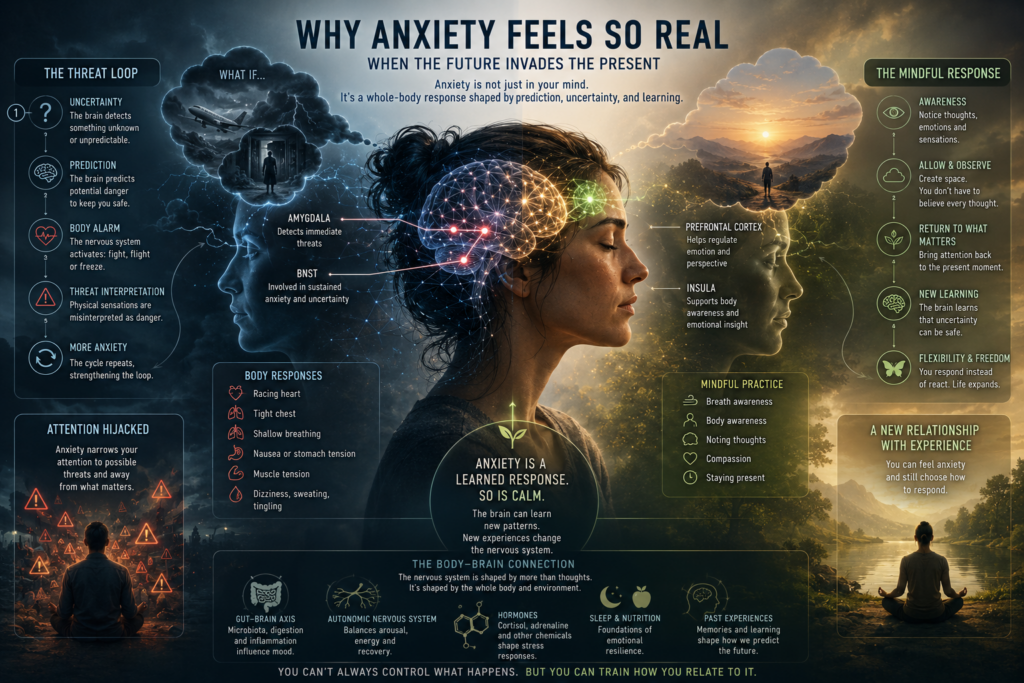
Why Anxiety Feels So Real: When the Future Invades the Present
Introduction
There is a kind of anxiety that arrives without warning.
It does not always appear in front of an obvious danger.
Sometimes it emerges while nothing seems to be happening.
While you are waiting.
Preparing to leave home.
Making an important decision.
Sitting quietly.
Or simply living what appears to be an ordinary day.
Outside, everything looks normal.
Inside, something begins to change.
Your breathing becomes shallower.
Your chest tightens.
Your heart beats faster.
Your attention starts searching for problems.
Your body behaves as though it has received urgent news.
Yet you cannot explain what that news is.
This is one of the most puzzling aspects of anxiety.
The body can enter a defensive state before the conscious mind fully understands why.
For many people, this experience feels deeply confusing.
“Why am I anxious when nothing is happening?”
“Why does my body react as if I’m in danger?”
Modern neuroscience offers an important answer.
Anxiety is not simply a feeling.
It is the expression of an entire biological system designed to anticipate uncertainty before certainty arrives.
Anxiety Is Not Always a Disorder
One of the most important misconceptions about anxiety is the belief that every anxious feeling is pathological.
It is not.
Anxiety is a normal and essential part of human biology.
In many situations, it serves an adaptive function.
Before an important examination.
A job interview.
A difficult conversation.
A medical appointment.
An important life decision.
A moderate increase in physiological arousal helps prepare the body for action.
Attention becomes sharper.
Energy is mobilized.
Reaction time improves.
Motivation increases.
From an evolutionary perspective, this response has obvious advantages.
Our ancestors who prepared for potential challenges were often more likely to survive than those who remained completely indifferent.
In this sense, anxiety is not the enemy.
It is one of the nervous system’s oldest protective strategies.
The difficulty begins when this protective mechanism loses flexibility.
When Anxiety Stops Protecting and Starts Limiting Life
Healthy anxiety rises when challenges appear.
It gradually settles once the situation has passed.
Problematic anxiety behaves differently.
The alarm becomes stronger than the actual situation requires.
It appears more frequently.
Lasts longer.
Persists after the perceived danger has disappeared.
Eventually, it begins shaping everyday life.
People start avoiding places.
Postponing decisions.
Seeking constant reassurance.
Checking repeatedly.
Trying to eliminate every possible uncertainty.
Over time, life quietly becomes smaller.
Not because opportunities disappear.
But because the nervous system increasingly interprets ordinary experiences as potential threats.
At this point, anxiety is no longer functioning simply as a warning signal.
It becomes a prison built from continuous anticipation.
Anxiety Begins With Uncertainty
One of the most useful ways to understand anxiety is to begin with uncertainty.
Psychologists David Grupe and Jack Nitschke, in an influential review published in Nature Reviews Neuroscience, described anxiety as a response that is fundamentally linked to the anticipation of uncertain threat.
This distinction is remarkably important.
Many people assume anxiety is simply fear.
Modern neuroscience suggests otherwise.
Often we are not anxious because something dangerous is happening.
We are anxious because we do not yet know what might happen.
Uncertainty creates a unique biological challenge.
It does not present the brain with a clear problem to solve.
It does not say:
“The danger is here.”
Instead, it whispers something much more difficult:
“Something could happen.”
Sometimes that possibility is enough to activate the nervous system.
Because the human brain was never designed merely to react.
It evolved to prepare.
Why Anxiety Feels So Real: The Brain Is Constantly Preparing for the Future
The brain is often described as the body’s prediction machine.
Its primary task is not only to interpret the present.
It is also to anticipate what might come next.
Every moment, it continuously evaluates the environment.
Scanning for patterns.
Searching for signals.
Estimating probabilities.
Building possible future scenarios.
Most of this happens automatically, outside conscious awareness.
When information is clear, prediction becomes relatively easy.
When information is incomplete, prediction becomes far more demanding.
The brain dislikes uncertainty because uncertainty makes accurate prediction more difficult.
To reduce this uncertainty, it begins searching for additional information.
Sometimes it finds real evidence.
Sometimes it fills the gaps with imagined possibilities.
The less certainty available…
the harder the predictive brain works.
Why Anxiety Grows in the Spaces Between Facts
Many anxious experiences begin not with danger itself…
but with missing information.
An unanswered message.
A medical result that has not yet arrived.
An ambiguous conversation.
An important decision left unresolved.
An unexpected silence.
An uncertain future.
These situations have something in common.
They leave questions unanswered.
The brain naturally tries to close those open loops.
When facts are unavailable, however, it often relies on hypotheses instead.
“Maybe something is wrong.”
“Perhaps I made a mistake.”
“What if the worst happens?”
These predictions may never become reality.
Yet the nervous system often responds to them as though they deserve immediate attention.
The hypothesis itself becomes biologically significant.
The body prepares.
Muscles tighten.
Breathing changes.
Attention narrows.
The future begins influencing the present.
This is one of the central reasons anxiety feels so real.
The threat may not yet exist outside us.
But the brain has already begun preparing as if it might.
WATCH THE VIDEO:
English Subtitles Available – Activate CC.
Why Anxiety Feels So Real: The Future Invades the Present
One of the defining characteristics of anxiety is that it brings tomorrow into today.
Instead of responding only to what is actually happening, the nervous system begins responding to what could happen.
The body prepares for imagined possibilities with many of the same biological mechanisms it would use for immediate danger.
This does not mean the brain is malfunctioning.
It means it is performing one of its oldest evolutionary functions:
protecting us before certainty arrives.
The difficulty arises when this protective system remains activated for too long.
When possibility becomes more influential than reality.
When prediction becomes more convincing than direct experience.
At that point, the future begins occupying the present.
Not only in our thoughts.
But throughout the entire organism.
And to understand why this happens, we must first answer another important question.
Although fear and anxiety are often treated as the same experience, modern neuroscience suggests they rely on partially different biological processes.
Understanding that distinction changes the way we understand anxiety itself.
Why Anxiety Feels So Real: Fear and Anxiety Are Not the Same Thing
In everyday language, fear and anxiety are often used interchangeably.
Modern neuroscience, however, suggests they are related but distinct experiences.
Fear usually has a clearer object.
You see something dangerous.
You recognize the threat.
Your body responds.
The situation is relatively immediate.
Anxiety often unfolds differently.
Its object is less defined.
It may involve a possibility rather than an event.
A future scenario rather than a present reality.
An uncertain outcome rather than an identifiable danger.
This distinction helps explain why anxiety can feel so confusing.
Many people say,
“I don’t know what I’m afraid of.”
From a neuroscientific perspective, that uncertainty is precisely part of the experience.
The nervous system is preparing for something that has not yet fully taken shape.
Why Anxiety Feels So Real: The Brain Can Prepare Before the Mind Understands
One of the most influential models for understanding this distinction was proposed by Joseph LeDoux and Daniel Pine.
Their Two-System Framework suggests that defensive responses and the conscious feeling of fear are not identical processes.
On one side are automatic defensive circuits.
These neural systems rapidly prepare the body to deal with possible danger.
On the other side is conscious emotional experience.
This is the subjective awareness we describe with words such as:
“I’m scared.”
“I’m anxious.”
“I’m worried.”
These two systems often work together.
But they are not exactly the same.
The body can begin preparing for danger before conscious awareness fully recognizes what is happening.
This explains why many people first notice physical symptoms.
Their heart races.
Their breathing changes.
Their muscles tighten.
Only afterwards do they begin asking,
“Why am I feeling this way?”
The nervous system has already begun its work.
Not because it is irrational.
But because it evolved to respond quickly.
Speed has often been more valuable for survival than certainty.
If you find this content helpful, You can support it with a free donation 🙏
Amygdala and BNST: Different Ways of Responding to Threat
Researchers have also discovered that anxiety involves multiple brain circuits rather than a single “fear center.”
Among the most studied structures are the amygdala and the bed nucleus of the stria terminalis (BNST).
Although these regions interact closely, they appear to contribute differently to defensive behaviour.
The amygdala is frequently associated with rapid responses to identifiable threats.
Imagine suddenly seeing a car speeding toward you.
Or hearing an unexpected explosion.
These situations demand an immediate reaction.
The amygdala helps coordinate that rapid defensive response.
The BNST appears to play a different role.
Rather than responding primarily to immediate danger, it seems particularly involved in more prolonged states of apprehension.
Especially when threats are:
- uncertain
- diffuse
- unpredictable
- difficult to define
This distinction helps explain why anxiety often feels different from fear.
Fear is frequently experienced as a sharp moment.
Anxiety is often experienced as an atmosphere.
Why Anxiety Feels So Real: Anxiety Can Feel Like a Climate
Many people describe anxiety as though they are constantly waiting for something to happen.
Not necessarily something specific.
Simply…
something.
This experience reflects one of anxiety’s defining characteristics.
The nervous system remains prepared.
Alert.
Listening.
Scanning.
As though danger might appear at any moment.
Instead of a brief defensive reaction, the body enters a prolonged state of readiness.
The future becomes psychologically present.
This sustained anticipation gradually influences perception itself.
Ordinary events begin attracting unusual significance.
A delayed message.
A brief silence.
A facial expression.
A change in someone’s tone of voice.
A small physical sensation.
None of these events necessarily indicate danger.
Yet within an anxious nervous system, they become potential evidence.
The brain begins asking:
“Could this mean something?”
“Should I worry?”
“Am I missing an important signal?”
The longer uncertainty remains unresolved…
the more active these predictive processes become.
Anxiety Changes What We Notice
One of anxiety’s most powerful effects is that it alters attention.
The world itself may remain unchanged.
Yet the way the brain selects information changes dramatically.
Human attention is limited.
At every moment, the brain must decide which pieces of information deserve priority.
Under ordinary circumstances, this system remains relatively balanced.
When anxiety increases, however, attention becomes increasingly biased toward possible threats.
Potential danger receives priority.
Neutral information receives less attention.
This shift made excellent evolutionary sense.
Detecting danger early often improved survival.
But in modern life, this same mechanism may become overactive.
The nervous system begins monitoring the environment almost continuously.
Searching.
Comparing.
Evaluating.
Preparing.
The result is not simply worry.
It is a different way of experiencing reality.
Why Anxiety Makes Concentration So Difficult
Psychologist Michael Eysenck and his colleagues proposed the Attentional Control Theory to explain many of these cognitive changes.
According to this model, anxiety reduces the efficiency with which we voluntarily direct attention.
Instead of focusing on the task we have chosen, attention is repeatedly pulled toward information that appears threatening.
This is why anxious people often report experiences such as:
“I can’t concentrate.”
“My mind keeps going back to the same problem.”
“Even when I’m working, part of me stays focused on what might go wrong.”
The difficulty is not necessarily a lack of intelligence or motivation.
Rather, attentional resources are being shared between the present task and the continuous monitoring of potential danger.
Imagine trying to read a book while someone repeatedly calls your name from another room.
You might continue reading.
But it requires much greater effort.
Something similar happens during anxiety.
Part of the mind remains occupied by possible future threats.
Even when nothing dangerous is actually happening.
Why Anxiety Is So Exhausting
Many people believe anxiety is exhausting simply because it feels unpleasant.
There is another important reason.
Anxiety consumes mental resources.
The brain continuously monitors the environment.
Checks internal sensations.
Evaluates possible risks.
Compares scenarios.
Predicts future outcomes.
Searches for reassurance.
Updates expectations.
All of these processes require energy.
The nervous system is working overtime.
It is as though numerous background applications remain open on a computer.
The system still functions.
But performance gradually slows.
Concentration declines.
Mental fatigue increases.
Decision-making becomes more difficult.
Even simple tasks may begin feeling surprisingly demanding.
This helps explain why anxiety often produces a profound sense of exhaustion even without intense physical activity.
The body is not resting.
It is maintaining an expensive state of biological readiness.
And that readiness extends far beyond the brain itself.
Because anxiety is never only a mental experience.
It is a whole-body state.
To understand why the heart races…
why breathing changes…
why the stomach tightens…
and why physical symptoms can become so convincing…
we must now explore how anxiety transforms the body itself.
Anxiety Is Not Only in the Brain
Although anxiety is often described as a psychological condition, it is never confined to the brain alone.
It involves the entire organism.
The brain continuously communicates with the heart.
The lungs.
The digestive system.
The immune system.
The endocrine system.
The muscles.
The skin.
The gut.
Every major physiological system participates in the body’s response to perceived threat.
This is why anxiety feels so physical.
When the nervous system evaluates a situation as potentially dangerous—or even biologically significant—it begins adjusting the body’s internal state.
The heart may beat faster.
Breathing may become shallower.
Muscles tighten.
Digestion slows.
Sweat glands become more active.
Blood flow is redistributed.
Attention narrows.
The body prepares for action.
These reactions are not imagined.
They are genuine physiological responses coordinated by the autonomic nervous system.
Why the Body Feels So Different During Anxiety
People experiencing anxiety often describe remarkably similar physical sensations.
A racing heart.
Chest tightness.
Shortness of breath.
A dry mouth.
Nausea.
Dizziness.
Muscle tension.
Trembling.
A lump in the throat.
Pins and needles.
A feeling of instability.
An upset stomach.
A sense that something is terribly wrong.
These symptoms can be frightening.
Especially when they appear suddenly.
Many people initially believe they are experiencing a serious medical emergency.
And in some situations, medical evaluation is absolutely appropriate, particularly when symptoms are new, severe, or unexplained.
However, once serious medical conditions have been excluded, neuroscience helps explain why anxiety alone can produce such convincing physical experiences.
The nervous system is preparing the body for survival.
It is doing exactly what it evolved to do.
The difficulty is not that these bodily changes are fake.
The difficulty is that they may occur in situations where immediate danger is absent.
Real Symptoms Do Not Always Mean Real Danger
One of the most important distinctions in understanding anxiety is this:
Real does not always mean dangerous.
A racing heart is real.
Chest tightness is real.
Shallow breathing is real.
Sweaty palms are real.
The sensation of dizziness is real.
What may not be accurate is the conclusion the brain immediately draws from those sensations.
Imagine noticing your heartbeat suddenly becoming stronger.
Within milliseconds, the predictive brain begins asking:
“Why is this happening?”
If the answer becomes,
“Something must be wrong.”
the nervous system receives a powerful message.
Danger.
It responds by increasing vigilance even further.
Heart rate rises again.
Breathing changes more dramatically.
Muscle tension increases.
The physical sensations become stronger.
The brain interprets those stronger sensations as further confirmation that danger exists.
A self-reinforcing cycle begins.
The Cycle That Keeps Anxiety Alive
This feedback loop is one of the most important mechanisms in anxiety.
It often unfolds so quickly that people barely notice each individual step.
First, a physical sensation appears.
Perhaps a skipped heartbeat.
A tight chest.
A brief feeling of dizziness.
The brain immediately interprets that sensation.
“What if something is wrong?”
That interpretation activates additional defensive responses.
The body becomes even more alert.
New sensations appear.
The brain receives what seems like further evidence.
“See? It really is dangerous.”
The cycle continues.
Notice what is happening here.
The body is responding to the brain.
The brain is responding to the body.
Each continuously influences the other.
This is not weakness.
It is biology.
The Body Becomes Louder During Stress
This cycle becomes especially powerful when the body is already under strain.
Sleep deprivation.
Chronic stress.
Poor nutrition.
Excessive caffeine.
Hormonal changes.
Physical illness.
Emotional overload.
All of these factors increase the background activity of the nervous system.
The body becomes noisier.
Small physiological fluctuations become easier to notice.
Meanwhile, the predictive brain becomes more suspicious.
Sensations that would normally pass unnoticed suddenly feel highly significant.
Many people conclude,
“If I feel this strongly, something serious must be happening.”
Yet the body is not always announcing immediate danger.
Sometimes it is simply revealing the biological cost of everything it has been carrying.
Accumulated tension.
Interrupted sleep.
Chronic vigilance.
Emotional exhaustion.
Long periods spent living in emergency mode.
The body speaks.
The challenge is learning to understand what it is actually saying.
The Gut and the Brain Never Stop Communicating
Modern neuroscience increasingly recognizes that anxiety cannot be understood by studying the brain in isolation.
The brain exists within a larger biological network.
One of the most fascinating examples is the gut-brain axis.
The digestive system and the central nervous system communicate continuously through multiple pathways.
These include:
- the vagus nerve
- immune signalling
- hormones
- metabolic products
- the gut microbiota
This communication occurs every day, whether we are aware of it or not.
Importantly, this does not mean the gut is always the cause of anxiety.
That would be an oversimplification.
Instead, the body’s overall physiological state influences how easily the nervous system shifts toward either safety or threat.
Inflammation.
Digestive disturbances.
Sleep disruption.
Irregular eating patterns.
Visceral sensitivity.
Chronic stress.
Each of these can modify the biological conditions under which anxiety becomes more or less likely.
The nervous system is constantly integrating information from the entire body.
It never evaluates the brain separately from the organism it belongs to.
Anxiety Emerges From a Network, Not a Single Organ
Perhaps one of the most important insights from contemporary neuroscience is that anxiety does not originate from a single location.
There is no isolated “anxiety center.”
Instead, anxiety emerges from the interaction of multiple systems working together.
The brain.
The autonomic nervous system.
The endocrine system.
The immune system.
The digestive system.
The cardiovascular system.
Past experiences.
Current relationships.
Environmental context.
Personal meaning.
All of these continuously influence one another.
This is why two people can encounter exactly the same situation while experiencing completely different levels of anxiety.
One person may experience public speaking as exciting.
Another experiences it as overwhelming.
One person sees an airplane as freedom.
Another sees loss of control.
One person interprets silence as neutral.
Another experiences it as abandonment.
The external situation certainly matters.
But it never tells the entire story.
What also matters is the history the nervous system has learned to associate with that situation.
Previous experiences.
Emotional learning.
Predictive models.
Automatic expectations.
Many of these memories are not stored as clear autobiographical stories.
They exist as tendencies.
Physiological responses.
Implicit predictions.
Automatic ways of relating to the world.
In this sense, anxiety is not a sign of weakness.
It is a form of learning.
Sometimes that learning has been highly adaptive.
Sometimes it has simply become too rigid.
And when protective learning becomes inflexible, one of the most powerful maintaining factors of anxiety begins to emerge:
avoidance.
Why Avoidance Feels Helpful… and Becomes a Trap
Avoidance often provides immediate relief.
You avoid the situation.
Your anxiety decreases.
The nervous system relaxes.
The brain registers this reduction in discomfort.
Unfortunately, it may also learn something unintended.
“Avoiding kept me safe.”
The next time a similar situation appears, anxiety returns even more quickly.
Avoidance again produces relief.
The cycle strengthens.
What initially felt like protection gradually becomes restriction.
Life becomes smaller.
Not because danger has increased.
But because the nervous system has become increasingly convinced that safety depends upon escape.
Breaking this cycle requires something more powerful than simply “thinking positively.”
It requires new learning.
And that is exactly where modern neuroscience and mindfulness begin to meet.
Anxiety Is Learned
If anxiety can become persistent, an important question naturally follows.
Can the nervous system learn something different?
Modern neuroscience suggests that it can.
This idea begins with a simple observation.
The nervous system is constantly learning from experience.
Every situation we encounter teaches the brain something about the world.
Safe.
Dangerous.
Predictable.
Unpredictable.
Relevant.
Irrelevant.
These lessons are not always conscious.
Many are stored as automatic tendencies.
Patterns of attention.
Physiological responses.
Implicit expectations.
Protective habits.
From this perspective, anxiety is not a sign of personal weakness.
It is a form of learning.
Sometimes that learning has been remarkably useful.
Sometimes it has simply become too rigid.
The problem is not that the nervous system protects us.
The problem is that it may continue protecting us long after the original danger has disappeared.
Why Avoidance Strengthens Anxiety
When anxiety becomes overwhelming, avoidance often feels like the most logical solution.
You avoid the situation.
The anxiety decreases.
Relief appears almost immediately.
The brain records this relief.
Unfortunately, it may also learn something unintended.
“Avoiding worked.”
The next time a similar situation appears, anxiety returns even faster.
Avoidance again produces relief.
The lesson becomes stronger.
Little by little, the nervous system begins treating avoidance itself as evidence that danger was real.
This creates one of the most powerful maintenance mechanisms in anxiety disorders.
Avoidance feels helpful in the short term.
But over time it quietly narrows life.
The world becomes smaller.
Not because danger has increased.
But because opportunities for new learning have disappeared.
Learning Safety Instead of Erasing Fear
Psychologist Michelle Craske and her colleagues introduced an important shift in our understanding of anxiety treatment through the concept of Inhibitory Learning.
Earlier approaches often assumed that recovery meant eliminating fear.
Modern learning theory suggests something more nuanced.
The goal is not necessarily to erase previous learning.
Instead, the nervous system gradually acquires additional learning.
New experiences begin competing with older predictions.
The brain discovers:
“This situation can be tolerated.”
“This sensation is uncomfortable, but not necessarily dangerous.”
“I can remain present even while anxiety is active.”
Rather than deleting fear, the nervous system expands its repertoire of responses.
This is an important distinction.
Recovery does not require becoming fearless.
It involves becoming more flexible.
Mindfulness Does Not Fight Anxiety
This perspective also changes how we understand mindfulness.
Mindfulness is often presented as a relaxation technique.
Sometimes it certainly produces relaxation.
But that is not its primary purpose.
Mindfulness does not force the nervous system to calm down.
It does not demand that anxiety disappear.
Instead, it changes our relationship with the experience itself.
Rather than automatically reacting to every internal signal, we begin observing those signals with greater clarity.
The anxious thought may still arise.
The physical sensation may still appear.
The prediction may still emerge.
What changes is our response.
We no longer have to follow every signal automatically.
That small difference can gradually transform the entire cycle of anxiety.
Attention Is Trainable
Researchers Scott Bishop and colleagues proposed an influential operational definition of mindfulness based on two essential components.
The first is self-regulation of attention.
The second is an attitude of openness, curiosity, and acceptance toward present experience.
These ideas are highly relevant to anxiety.
The anxious mind is often characterized by attentional capture.
Thoughts immediately become reality.
Sensations immediately become danger.
Images immediately become predictions.
Mindfulness interrupts this automatic fusion.
It teaches attention to notice experience without immediately becoming consumed by it.
A thought remains a thought.
A sensation remains a sensation.
An emotion remains an emotion.
They no longer need to become unquestionable facts.
The Brain Can Learn New Patterns
This capacity for change is closely related to one of the most remarkable properties of the nervous system:
neuroplasticity.
Repeated experience gradually reshapes neural networks.
The brain continuously adapts to what we repeatedly practice.
Reviews by Yi-Yuan Tang, Britta Hölzel, and Michael Posner have described mindfulness practice as being associated with changes in brain networks involved in:
- attention
- body awareness
- emotional regulation
- self-related processing
Similarly, research by Britta Hölzel and colleagues reported changes in gray matter density following an eight-week Mindfulness-Based Stress Reduction (MBSR) program in regions associated with learning, memory, emotional regulation, and perspective taking.
These findings should not be turned into exaggerated promises.
They do not suggest that every person experiences identical changes.
Nor do they imply that mindfulness replaces psychotherapy, medical evaluation, or medication when these are needed.
Instead, they point toward something both modest and deeply hopeful.
Repeated experience shapes the brain.
Practice is repeated experience.
Every return of attention becomes another opportunity for learning.
A Different Relationship With Experience
When you gently bring attention back to the breath…
you are not simply relaxing.
You are training attention not to be captured by every passing thought.
When you notice tightness in your chest without immediately escaping from it…
you are not denying anxiety.
You are allowing the nervous system to discover that the sensation can be experienced without automatically triggering avoidance.
When you recognize,
“I’m having the thought that something terrible will happen,”
you are not arguing with the thought.
You are recognizing it as a mental event.
Not as an unquestionable prediction.
This shift may appear subtle.
Its consequences can be profound.
Because anxiety is often maintained not only by what we experience…
but by the relationship we have with that experience.
If every heartbeat means danger…
every sensation becomes evidence.
If every anxious thought predicts reality…
every prediction becomes frightening.
Mindfulness changes that relationship.
The heart beats faster.
You notice:
“Heartbeat.”
Breathing changes.
You notice:
“Breathing.”
A catastrophic scenario appears.
You notice:
“Thinking.”
Not to become emotionally detached.
But to become less automatically governed by every internal event.
A Simple Mindfulness Practice
You can experience this difference right now.
Do not try to eliminate anxiety.
Do not force yourself to relax.
Simply notice three points of contact.
Your feet touching the floor.
The movement of your breathing.
The weight of your hands.
Now notice whether a thought appears.
Do not follow it.
Do not push it away.
Simply give it a gentle name.
“Worry.”
“Memory.”
“Planning.”
“Judgment.”
“Control.”
Then return once more to the body.
The feet.
The breath.
The hands.
This practice may appear surprisingly simple.
Yet each return interrupts an automatic habit.
Each return quietly teaches the brain:
“I do not have to follow every thought that appears.”
Little by little, a space begins to emerge.
Between sensation and interpretation.
Between thought and reaction.
Between uncertainty and action.
Within that space, new possibilities become available.
Conclusion
Anxiety is not your enemy.
It is a protective system that has learned to anticipate danger.
Sometimes wisely.
Sometimes excessively.
Sometimes long after the original threat has disappeared.
Because anxiety is learned, it can also encounter new learning.
This does not mean life becomes free of uncertainty.
It means we gradually develop a different way of relating to uncertainty.
Mindfulness does not promise a life without fear.
It offers something both more realistic and more profound.
The possibility of no longer being governed by every fear.
The possibility of listening to the body without becoming imprisoned by every sensation.
Of seeing thoughts without automatically accepting them as reality.
Of remaining present even when uncertainty exists.
Again and again, we return.
To the breath.
To the body.
To awareness.
Not because these erase anxiety.
But because they remind us that we are larger than any single anxious moment.
Perhaps that is where genuine freedom begins.
Not in controlling every future possibility.
But in discovering that we do not need to obey every prediction our mind creates.
Because life is not lived inside imagined futures.
It is lived here.
In this breath.
In this moment.
In the only place where experience is ever truly real:
the present.
Frequently Asked Questions (FAQ)
Is anxiety always a mental health disorder?
No. Anxiety is a normal biological response that prepares us for challenges and uncertainty. It becomes problematic when it is excessive, persistent, or begins restricting everyday life.
What is the difference between fear and anxiety?
Fear usually responds to an immediate and identifiable threat. Anxiety is more commonly associated with uncertain, future-oriented, or unpredictable situations.
Why does anxiety produce real physical symptoms?
Anxiety activates the autonomic nervous system, leading to genuine physiological changes such as increased heart rate, muscle tension, rapid breathing, dizziness, sweating, and digestive changes. These symptoms are real, although they do not necessarily indicate physical danger.
What is the gut-brain axis?
The gut-brain axis is the continuous communication network linking the digestive system, the brain, the immune system, hormones, the vagus nerve, and the gut microbiota. These systems influence one another and contribute to emotional regulation.
How does mindfulness help with anxiety?
Mindfulness helps people observe thoughts, emotions, and bodily sensations without automatically reacting to them. It strengthens attention, body awareness, emotional regulation, and psychological flexibility while supporting new patterns of learning within the nervous system.
This is THE MINDFUL LAB
A space where Mindfulness, Neuroscience, Spirituality, and Human Experience merge to promote self-knowledge and personal growth.
If you found this article helpful, please like it, share it with someone you care about, subscribe to our newsletter, and explore our YouTube channel.

Suggested Internal Links:
-
- https://www.tobejoyfultobesoul.com/2026/07/17/are-you-loving-the-other-person-or-your-story/
- https://www.tobejoyfultobesoul.com/2026/07/17/are-you-really-overreacting/
- https://www.tobejoyfultobesoul.com/2026/07/17/why-chronic-stress-can-lead-to-inflammation/ https://www.tobejoyfultobesoul.com/2026/05/05/stress-and-the-immune-system/
- https://www.tobejoyfultobesoul.com/2026/04/27/where-stress-comes-from-the-real-reasons-behind-your-discomfort/
- https://www.tobejoyfultobesoul.com/2026/04/07/living-on-autopilot/
- https://www.tobejoyfultobesoul.com/2026/03/30/thinking-about-the-past/
- https://www.tobejoyfultobesoul.com/2026/03/24/how-to-calm-your-mind/
- https://www.tobejoyfultobesoul.com/2026/03/24/why-the-mind-never-stops-thinking/
Suggested External Scientific Sources
- PubMed
- National Center for Biotechnology Information (NCBI)
- Nature Reviews Neuroscience
- Frontiers in Human Neuroscience
- Frontiers in Psychology
- National Institute of Mental Health (NIMH)
- American Psychological Association (APA)
- Society for Neuroscience
SCIENTIFIC SOURCES & REFERENCES:
Grupe & Nitschke, 2013 — Uncertainty and anticipation in anxiety
LeDoux & Pine, 2016 — Using Neuroscience to Help Understand Fear and Anxiety
Davis, Walker, Miles & Grillon, 2010 — Phasic vs sustained fear in rats and humans
Eysenck, Derakshan, Santos & Calvo, 2007 — Anxiety and cognitive performance: Attentional Control Theory
Critchley, Wiens, Rotshtein, Öhman & Dolan, 2004 — Neural systems supporting interoceptive awareness
Paulus & Stein, 2006 — An Insular View of Anxiety
Paulus & Stein, 2010 — Interoception in anxiety and depression
Newman & Llera, 2011 — A novel theory of experiential avoidance in generalized anxiety disorder
Craske, Treanor, Conway, Zbozinek & Vervliet, 2014 — Maximizing exposure therapy: An inhibitory learning approach
Bishop, Lau, Shapiro, Carlson, Anderson, Carmody, Segal, Abbey, Speca, Velting & Devins, 2004 — Mindfulness: A Proposed Operational Definition
Tang, Hölzel & Posner, 2015 — The neuroscience of mindfulness meditation
Hölzel, Carmody, Vangel, Congleton, Yerramsetti, Gard & Lazar, 2011 — Mindfulness practice leads to increases in regional brain gray matter density
Goyal, Singh, Sibinga, Gould, Rowland-Seymour, Sharma, Berger, Sleicher, Maron, Shihab, Ranasinghe, Linn, Saha, Bass & Haythornthwaite, 2014 — Meditation programs for psychological stress and well-being
Hofmann, Sawyer, Witt & Oh, 2010 — The effect of mindfulness-based therapy on anxiety and depression
Your contribution helps develop content dedicated to awareness, well-being, and inner transformation. Even a small contribution can make a difference.
Thank you so much. 🙏
Discover more from THE MINDFUL LAB
Subscribe to get the latest posts sent to your email.