PATHS OF INNER GROWTH – Reiki, Pranic Healing, Mindfulness, Neuroscience, and the Journey Toward Greater Awareness
There are moments when life seems to ask something more of us.
Not necessarily because everything is going wrong. Sometimes, at least outwardly, we continue with our activities, fulfill our commitments, and maintain our relationships. And yet, beneath the surface, we feel increasingly distant from ourselves.
We may feel tired without fully understanding why.
We may have the sense that we keep repeating the same behaviors, reacting to situations automatically, or living according to expectations that no longer belong to us.
At other times, however, it is a specific difficulty that interrupts our usual rhythm:
- a period of stress;
- a personal crisis;
- physical or emotional discomfort;
- the end of a relationship;
- an unexpected change;
- the loss of a sense of direction;
- a question about the meaning of our existence.
It is often during these transitions that the desire to embark on a path of inner growth arises.
We do not always know exactly what we are looking for. We simply know that the way we have lived up to that point is no longer enough.
For some people, the encounter happens through meditation or mindfulness. For others, through yoga, Reiki, Pranic Healing, or different spiritual traditions. The paths may be many, but they share a fundamental question:
How can I reconnect with the most authentic part of myself?
Reiki and Pranic Healing can represent two possible responses to this question when they are experienced not merely as techniques aimed at well-being, but as disciplines capable of involving the way we perceive, think, act, and relate to life.
What Inner Growth Really Means
Inner growth does not mean becoming a different person from who we are.
It does not mean eliminating every vulnerability, controlling every emotion, or reaching a permanent state of serenity.
It means, first of all, becoming more aware.
Aware of what we feel.
Of what drives us.
Of the reactions we enact automatically.
Of the beliefs that guide our choices.
Of the needs we neglect.
Of the behaviors through which we seek protection, approval, or security.
Growing means learning to recognize all of this without completely identifying with what emerges.
An emotion does not define the whole person.
A thought does not necessarily represent reality.
A learned reaction is not an unchangeable destiny.
A wound is not our entire identity.
Inner growth begins when we create a space between what happens within us and the response we choose to give.
In that space, a new form of freedom emerges.
Not the freedom to control every event, but the freedom to meet experience with greater presence, discernment, and responsibility.
From the Desire to Feel Better to the Search for the Self
Many people approach Reiki or Pranic Healing because they are going through a difficult period.
The initial motivation may be very practical: to relax, regain energy, cope better with stress, or receive support during a demanding time.
A treatment is often the first point of contact with these disciplines.
In Reiki, the practitioner gently places the hands on the person’s body or holds them a short distance away, depending on the method and individual needs. In Pranic Healing, treatment is traditionally performed without physical contact and includes procedures that the discipline describes as assessment, cleansing, and energizing of the energy field.
These are two distinct systems, with different origins, techniques, and training paths. Both, however, interpret the human being through a perspective that does not sharply separate body, mind, emotions, and the spiritual dimension.
According to their respective traditions, personal balance is connected with the quality and circulation of vital energy.
Reiki uses the Japanese term ki.
Pranic Healing refers to prana, a Sanskrit word meaning vital breath or life force.
In the Chinese tradition, we find the concept of qi.
These terms arise from different cultural contexts and should not automatically be regarded as equivalent. They do, however, express an idea shared by many traditional systems: life is not understood solely through visible matter, but also through a dynamic principle that animates, connects, and sustains the organism.
Contemporary science has not demonstrated the existence of subtle energy in the terms in which these disciplines describe it. Reiki and Pranic Healing should therefore be presented while respecting the distinction between traditional language, subjective experience, and scientific evidence.
This does not prevent us from exploring the value that these practices may have in a person’s life.
Research on Reiki has produced interesting but not yet conclusive findings: some reviews report possible benefits for anxiety, relaxation, and quality of life, while also emphasizing the heterogeneity of the studies and the need for more rigorous research. Reiki is generally classified in the health literature as a complementary practice or “biofield therapy,” not as a substitute for medical care.
For this reason, the deeper meaning of such a path should not be sought in the promise of guaranteed healing.
Rather, it may be found in the way the practice invites a person to stop, listen inwardly, and take more conscious responsibility for their own life.
It is here that the original question may begin to change.
No longer only:
What can this discipline do for me?
But:
What can I learn about myself through this discipline?
A Treatment Can Be a Doorway, Not the Destination
Receiving a treatment is primarily a receptive experience.
The person entrusts themselves to the practitioner, enters a space of quiet, and allows the body to slow down. This can offer a valuable moment of listening, especially when everyday life is dominated by haste, worries, and continuous mental activity.
But an authentic path of growth cannot remain entirely passive.
At a certain point, the need emerges to bring what was perceived during the treatment into everyday life.
How do we treat ourselves when no one is watching?
How do we react when we feel criticized?
How much space do we give to our authentic needs?
Can we recognize the moment when tiredness becomes exhaustion?
Can we distinguish intuition from fear?
Which emotions do we continue to avoid?
Which behaviors do we repeat even though we know they are not good for us?
A treatment may make an inner condition more visible, but it cannot make all the choices required for transformation on our behalf.
Daily practice then becomes the bridge between the experience we receive and the concrete way we live.
Awareness Does Not Arise from a Single Experience
An intense experience can open a door.
It can make us feel deeply relaxed, inspired, or connected.
It can offer us an important insight.
It can reveal a possibility that we were previously unable to see.
But lasting transformation requires something different: continuity.
Inner change is built through repeated actions:
- pausing before reacting;
- listening to the body;
- observing thoughts;
- recognizing emotions;
- meditating;
- taking care of our habits;
- respecting our limits;
- cultivating gratitude;
- practicing kindness;
- correcting a behavior when we realize that it causes suffering;
- learning to begin again without condemning ourselves.
From this perspective, spiritual and psychological language can meet.
Traditions speak of purification, discipline, centering, or the elevation of consciousness.
Neuroscience speaks of learning, attention, emotional regulation, and neuroplasticity.
These are not interchangeable explanations. We cannot use neuroscience to prove the existence of chakras or universal energy. We can, however, recognize one concrete principle: what we practice repeatedly can change the way the mind processes experience.
Studies on mindfulness and meditation associate consistent practice with changes in attention, body awareness, emotional regulation, and self-perception. Some neuroimaging studies have also observed functional or structural changes in brain networks involved in learning, memory, interoception, and emotional regulation. These findings always require cautious interpretation, but they show that mental practice is not necessarily an abstract experience: it can involve processes of bodily and neural learning.
Not Eliminating Emotions, but Learning to Move Through Them
One of the most problematic interpretations of spiritual growth is the belief that an evolved person should no longer experience anger, fear, sadness, jealousy, or worry.
In reality, growth does not mean the absence of emotions.
It means developing the ability to recognize them without being completely driven by them.
Anger can signal that a boundary has been crossed.
Fear can warn us of a danger, whether real or perceived.
Sadness can accompany a loss.
Worry may arise from the mind’s attempt to anticipate what might happen.
The problem is not the existence of the emotion. The problem arises when the reaction becomes automatic, disproportionate, or persistent.
An inner practice can teach us to remain present while the emotional experience unfolds.
This does not mean suppressing it.
It does not mean telling ourselves that everything is fine when it is not.
It means learning to observe the emotion, listen to what it is communicating, and choose how to respond.
The mindfulness literature distinguishes, although inevitably in simplified terms, between more intentional processes of emotional regulation and processes that, with experience, may become more spontaneous and less reactive. Practice does not erase emotions: it can change the relationship we develop with them.
The Body as a Place of Awareness
Inner growth does not happen only through thoughts.
It happens in the body.
It is in the body that we perceive anxiety even before we are able to name it.
It is in the body that tension manifests.
It is through the breath that we can realize we are in a state of alert.
It is in posture, heartbeat, muscular contraction, or fatigue that we recognize how we are moving through a situation.
Reiki and Pranic Healing place great importance on the bodily and energetic dimension, although they use different maps and methods.
Mindfulness, on the other hand, speaks of awareness of sensations, breathing, and internal states.
Neuroscience uses the term interoception to describe the perception of signals coming from within the organism.
These are distinct perspectives, but they can meet in the invitation not to treat the body simply as a tool to be used as long as it works.
The body is part of our experience.
Listening to it does not mean blindly obeying every sensation. It means learning to recognize its signals, integrate them with thought, and respond with greater care.
Slow and conscious breathing, which is present in many contemplative practices, has also been studied for its effects on autonomic systems and psychological states. It is not a universal solution, but it provides a concrete example of how an apparently simple action can influence the way we move through experience.
Personal Responsibility Is Not Blame
In older ways of speaking about energy disciplines, we sometimes encounter a problematic idea: the belief that a person, through “wrong” thoughts, emotions, or behaviors, is directly responsible for causing their own illnesses.
This belief needs to be overcome.
Health depends on many factors:
- genetic;
- biological;
- psychological;
- environmental;
- social;
- economic;
- relational;
- behavioral.
Not everything that happens can be controlled by individual will.
Becoming ill is not a spiritual failure.
Experiencing anxiety does not mean that our thoughts are not positive enough.
Experiencing trauma does not mean that we attracted it.
Not healing does not mean that we did not try hard enough.
Personal responsibility means something else.
It means recognizing the areas in which we can take action without blaming ourselves for what is beyond our control.
We can take care of our sleep.
We can ask for help.
We can observe our habits.
We can learn to set boundaries.
We can follow medical advice.
We can cultivate healthier relationships.
We can practice Reiki, meditation, or other complementary disciplines when they help us move through our journey with greater presence.
Authentic responsibility does not condemn.
It restores possibility.
Paths of Inner Growth – Reiki and Pranic Healing as Disciplines, Not Shortcuts
Every spiritual path can be turned into a shortcut.
We may search for a technique capable of immediately eliminating discomfort.
We may chase extraordinary experiences.
We may accumulate courses, levels, and certifications without changing the way we live.
We may use the language of energy to avoid facing a psychological, relational, or practical difficulty.
We may even turn spirituality into a new identity through which we feel superior to others.
But an authentic path is not measured by the number of symbols we know, by the experiences we perceive during meditation, or by the energetic sensitivity we develop.
It reveals itself in everyday life.
In the way we treat those who can offer us nothing.
In the way we face conflict.
In our ability to admit a mistake.
In our respect for other people’s boundaries.
In the honesty with which we examine our motivations.
In the consistency between what we say and what we do.
Both within the Reiki system and within the path proposed by Master Choa Kok Sui, practice is not presented merely as a collection of techniques. Their respective traditions include precepts, meditation, discipline, character development, and service. The Five Principles, or Gokai, form a central part of the Reiki system, while Arhatic Yoga is described by organizations that transmit Choa Kok Sui’s teachings as a structured path of spiritual development and a synthesis of different yogic practices.
It is within this dimension that Reiki and Pranic Healing can become authentic inner paths.
Not because they promise to remove us from the difficulties of life.
But because they can teach us to meet those difficulties with a different state of consciousness.
The Return to Ourselves
Inner growth does not mean rising above the human experience.
It means entering it more deeply.
Learning to inhabit the body without fighting it.
Recognizing emotions without being overwhelmed by them.
Observing the mind without automatically believing every thought.
Caring for ourselves without closing ourselves off from others.
Cultivating the spiritual dimension without losing contact with reality.
An authentic path does not remove us from ordinary life.
It brings us back into it.
With greater presence.
With greater sensitivity.
With a more mature sense of responsibility.
With the ability to recognize what nourishes our existence and what, instead, continues to drain our energy.
Reiki and Pranic Healing can represent two different paths through which we may approach this process.
To understand their value, however, it is necessary to enter into the specific structure of each path: its origins, principles, practices, levels of training, and the spiritual vision that supports it.
And it is with Reiki, its history, and its Five Principles that we will begin this journey.
Reiki: A Path of Inner Transformation
Today, Reiki is best known as a practice of energetic balancing through the laying on of hands.
Although this description is correct, it tells only a small part of what Reiki actually represents.
In the tradition founded by Mikao Usui (1865–1926) in Japan at the beginning of the twentieth century, Reiki was first and foremost conceived as a path of spiritual growth and personal development.
The very term Reiki reflects this perspective.
The word is composed of two Japanese ideograms.
Rei is traditionally interpreted as “universal,” “spiritual,” “mysterious,” or “higher wisdom.”
Ki, on the other hand, refers to the vital energy that, according to many Eastern traditions, animates all living beings.
In Chinese culture, a related concept is represented by Qi, while in the Indian tradition we find the term Prāṇa.
Although these concepts belong to different philosophical systems and are not perfectly interchangeable, they share the idea that life cannot be understood exclusively through observable matter.
For Reiki, therefore, the treatment represents only one of the tools through which a person may develop a deeper relationship with themselves.
The ultimate goal is not simply to seek well-being, but to cultivate greater harmony between body, mind, and the spiritual dimension, according to the perspective of the discipline itself.
The Origins of Reiki
The history of Reiki is closely connected with the figure of Mikao Usui, born in Japan in 1865.
According to tradition, after years of studying Buddhist spiritual practices, Shintoism, meditation, and different philosophical disciplines, Usui undertook an intense period of meditative retreat on Mount Kurama, near Kyoto.
During this retreat, tradition holds that he experienced a profound spiritual transformation from which the method now known as Usui Reiki Ryōhō (“Usui Spiritual Healing Method”) emerged.
Beyond the narrative elements surrounding this episode, the available historical documentation confirms that Mikao Usui developed a structured system of practice, meditation, treatment, and personal growth, which he continued to teach until his death in 1926.
After Usui, the method was transmitted by Chujiro Hayashi, a physician in the Imperial Japanese Navy, who contributed to organizing and systematizing the teaching.
Later, Hawayo Takata spread Reiki in Hawaii, the United States, and from there to the rest of the world.
Today, many schools and different interpretations of Reiki exist, but most still recognize their roots in the system developed by Mikao Usui.
The Heart of Reiki Is Not the Treatments
When observing a Reiki session from the outside, attention is naturally drawn to the position of the hands.
It might therefore seem that the treatment itself is the most important element of the discipline.
In reality, within the Usui tradition, treatment represents only one part of the path.
True change arises from daily practice.
Meditation.
Self-treatment.
Presence.
Discipline.
Self-observation.
Kindness.
Gratitude.
Personal responsibility.
These are the elements that allow Reiki to be transformed from a simple technique into a way of life.
Mikao Usui’s original intention was not simply to create a therapeutic method.
It was to offer people a path through which they could cultivate serenity, balance, and spiritual growth in everyday life.
The Five Principles of Reiki
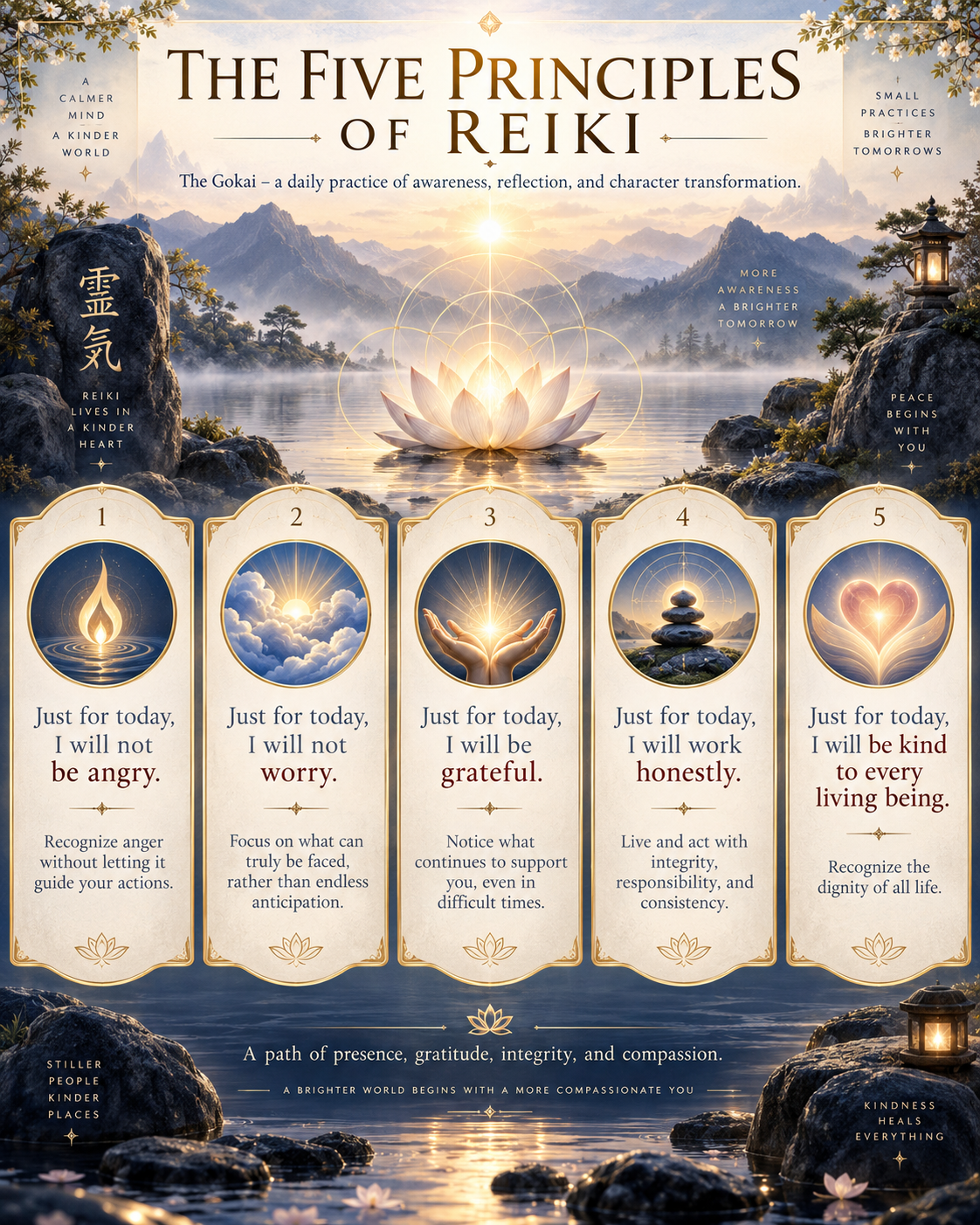
If there is an essential core to Mikao Usui’s entire teaching, it is represented by the Gokai, the Five Principles of Reiki.
Usui encouraged his students to recite them every day as a practice of reflection and character transformation.
More than moral rules, they are a training in awareness.
Just for today, I will not be angry.
This does not mean suppressing anger.
It means learning to recognize it without allowing it to automatically guide our actions.
Just for today, I will not worry.
The invitation is not to ignore problems.
Rather, it is to distinguish what we can actually address from the endless anticipations created by the mind.
Just for today, I will be grateful.
Gratitude does not mean denying difficulties.
It means also recognizing what continues to support us, even during difficult times.
Just for today, I will work honestly.
Honesty concerns work, but also the way we live every relationship.
It means acting with integrity, responsibility, and consistency.
Just for today, I will be kind to every living being.
Kindness is not weakness.
It is the ability to recognize in others the same dignity that we desire for ourselves.
It is interesting to observe how these principles today find points of contact with many areas of contemporary psychological research.
Anger regulation, gratitude, compassion, present-moment awareness, and prosocial behavior are all receiving increasing attention within affective neuroscience and the psychology of well-being.
This does not mean that such research proves Reiki.
Rather, it means that some of the human qualities cultivated within the Reiki tradition are also being studied today through scientific methods, although within different theoretical frameworks.
Attunements (Reiju)
One of the most distinctive aspects of Reiki is represented by attunements, known in the Japanese tradition as Reiju.
During this process, the teacher guides the student through a specific transmission ritual according to the school to which they belong.
From the traditional Reiki perspective, Reiju is not considered merely a symbolic ceremony.
It represents the beginning of a new way of practicing and relating to the spiritual path.
Its meaning, however, should not be interpreted as an endpoint.
The attunement opens a possibility.
Daily practice is what brings it to life.
For this reason, many Reiki Masters emphasize that no attunement can replace personal discipline, self-observation, and consistent commitment to one’s own growth.
The Four Levels of Reiki
Most contemporary Reiki schools organize their teaching into four main levels.
Although there are some differences among traditions, the overall structure remains similar.
First Level
The practitioner learns the history of Reiki, its fundamental principles, and the hand positions.
The focus is primarily on self-treatment and in-person treatment.
This is the level at which the relationship with daily practice begins to develop.
Second Level
Traditional Reiki symbols and distance-treatment techniques are introduced according to the teachings of the specific school.
The focus expands from the personal level to the relationship with others.
Third Level
This is generally regarded as the level of spiritual maturation.
The goal is not to acquire “more power,” but to cultivate greater responsibility, presence, and awareness.
Many schools introduce the Master symbol at this stage.
Master Level
The fourth level is intended for those who wish to transmit Reiki to others.
Being a Master does not simply mean teaching a technique.
It means taking responsibility for accompanying other human beings along a path of growth.
The quality of the teaching therefore depends not only on theoretical knowledge, but above all on the consistency with which the Master lives the principles of Reiki in everyday life.
A Path That Continues Every Day
Perhaps the most important message of Reiki is surprisingly simple.
Transformation does not take place during a single treatment.
It takes place in everyday life.
Every time we choose presence instead of automatic reaction.
Gratitude instead of constant complaint.
Responsibility instead of blame.
Kindness instead of reactivity.
Discernment instead of impulse.
It is through these small daily choices that Reiki, according to its tradition, ceases to be merely a practice and becomes an authentic path of inner growth.
If you find this content useful, you can support it with a free donation. 🙏
Pranic Healing: A Path of Purification, Balance, and Development of Consciousness
If Reiki originated in Japan at the beginning of the twentieth century, Pranic Healing is a more recent system, developed in the second half of the twentieth century by Filipino-Chinese Master Choa Kok Sui (1952–2007).
Although modern in the way it is organized, Pranic Healing presents itself as a synthesis of knowledge drawn from different spiritual and philosophical traditions, including Yoga, Taoism, Buddhism, Hinduism, and various Eastern energy practices.
According to the teachings of Choa Kok Sui, these traditions share a fundamental principle: the human being is not made up solely of the physical body, but also includes an energetic component that constantly interacts with the mental, emotional, and spiritual aspects of the person.
The term Prana, from Sanskrit, literally means vital energy or breath of life.
In Traditional Chinese Medicine, we find a related concept in Qi, while Japanese culture uses the term Ki.
Here too, it is important to remember that these concepts belong to different philosophical systems and should not automatically be regarded as equivalent. They represent different ways of interpreting the functioning of life within their respective traditions.
Pranic Healing organizes these teachings into a structured method of personal practice, energy treatment, meditation, and character development.
A Distinctive Feature: Treatment Without Physical Contact
One of the aspects that most clearly distinguishes Pranic Healing from Reiki is the way treatment is performed.
In Reiki, the practitioner generally places the hands on the body or keeps them a short distance away.
In Pranic Healing, by contrast, treatment is traditionally performed without any physical contact.
According to the discipline, the practitioner works on the so-called energy body, described as a subtle structure interconnected with the physical body.
The procedure generally involves three fundamental stages:
- energetic assessment (scanning);
- cleansing or removal of energies considered congested (cleansing);
- subsequent energizing (energizing).
This description reflects the theoretical model of Pranic Healing itself.
To date, these concepts have not received direct confirmation within evidence-based medicine and should be understood within the conceptual framework of the discipline.
For many people, however, the practice represents an experience of relaxation, concentration, and awareness that may accompany a personal path toward well-being, without replacing medical treatment when needed.
The Role of the Chakras in Pranic Healing
Among the best-known elements of Pranic Healing is the system of chakras.
The Sanskrit term chakra means “wheel” or “disk” and appears in various Yoga and Tantra texts.
Within the Pranic Healing tradition, chakras are described as centers through which vital energy is absorbed, distributed, and used by the organism.
Master Choa Kok Sui developed a detailed classification of major and minor chakras, attributing specific energetic, emotional, and psychological functions to each of them.
It is important to distinguish this model from the anatomical knowledge of modern medicine.
Chakras do not correspond to observable anatomical structures and belong to the energetic worldview of the discipline.
For this reason, they are generally interpreted as elements of spiritual tradition rather than physical organs.
A Progressive Training Path
One of the most interesting aspects of Pranic Healing is its highly structured organization.
The path is not limited to learning a technique, but proposes a progressive process of study and practice.
Course names may vary slightly among different authorized organizations, but the general structure normally includes:
Basic Pranic Healing
This represents the first level.
The student learns the fundamental principles of the system, the theory of the energy body, techniques of assessment, cleansing, and energizing, and the safety guidelines established by the discipline.
Particular attention is given to personal responsibility and regular practice.
Advanced Pranic Healing
At the advanced level, more complex techniques and a more refined use of energy are introduced according to the model developed by Master Choa Kok Sui.
The aim is not to increase the practitioner’s “power,” but to develop greater precision, sensitivity, and discipline.
Pranic Psychotherapy
This course addresses, according to the Pranic Healing model, the relationship between emotional states, mental patterns, and the energy body.
Although it uses the term “psychotherapy,” it does not correspond to clinical psychotherapy as recognized within healthcare professions.
It is an internal teaching within the Pranic Healing system and does not replace psychological or psychotherapeutic treatment provided by qualified professionals.
This distinction is essential in order to avoid misunderstanding.
Crystal Healing
Master Choa Kok Sui dedicated an entire training path to the use of crystals.
According to the discipline, certain crystals, when appropriately prepared and used, may amplify or modulate the practitioner’s energetic work.
This view belongs to the Pranic Healing tradition and is not confirmed by scientific research.
For many practitioners, crystals primarily serve as symbolic and ritual tools that accompany the practice.
Psychic Self-Defense
This teaching addresses the subject of energetic protection according to the theoretical model of Pranic Healing.
The discipline proposes practices for cleansing, strengthening, and managing one’s inner balance.
Here too, these concepts belong to the spiritual tradition of the system.
Achieving Oneness with the Higher Soul
With this course, the path takes on an increasingly contemplative dimension.
The focus gradually shifts from technique to the transformation of consciousness.
The goal becomes developing a more stable relationship with what Choa Kok Sui calls the Higher Soul, through meditation, service, and inner practice.
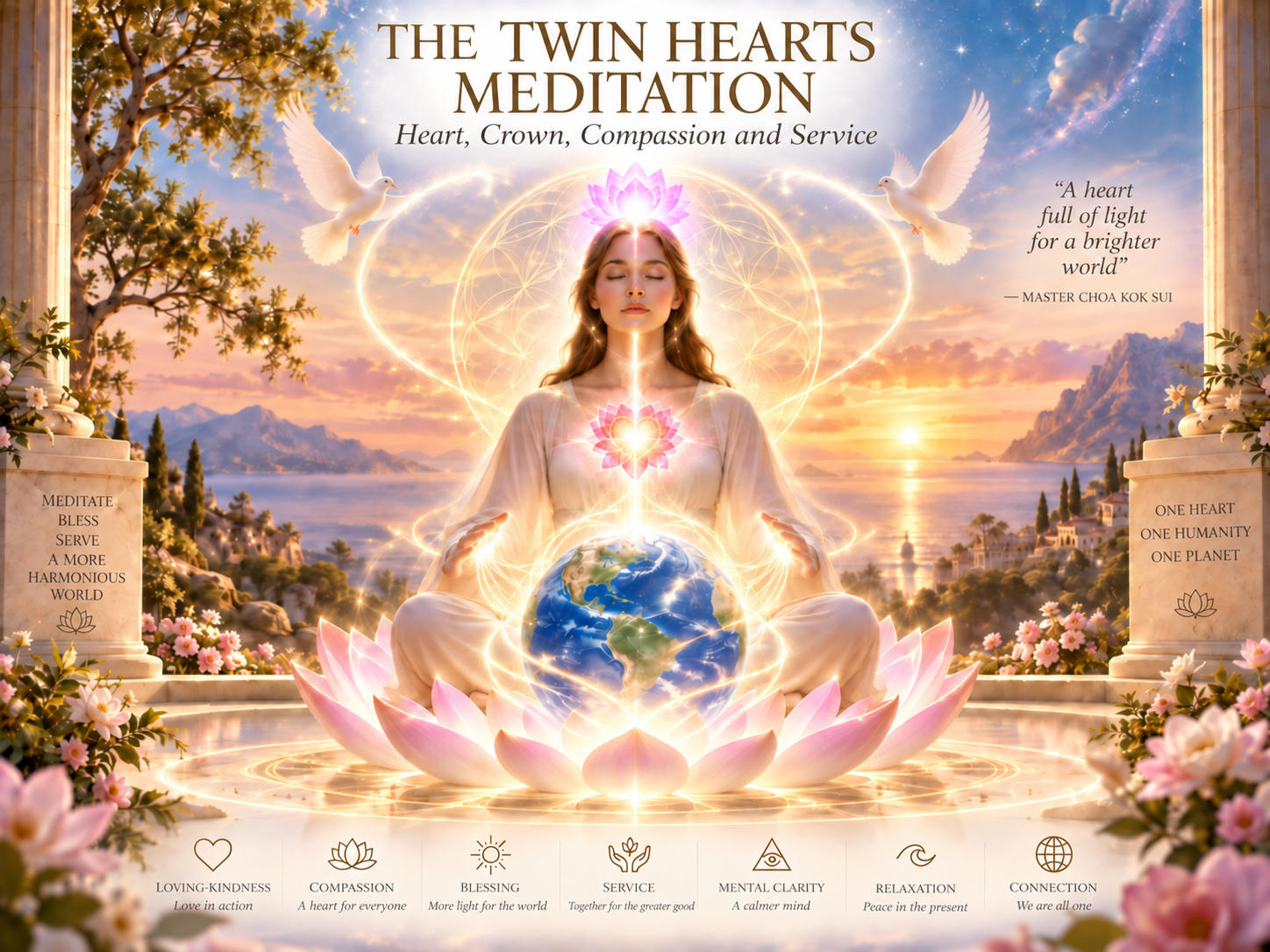
Meditation on Twin Hearts
Among the best-known teachings of Master Choa Kok Sui is the Meditation on Twin Hearts, probably one of the most widely practiced techniques within the system.
This meditation takes its name from the two energy centers to which the tradition assigns a central role:
- the heart chakra;
- the crown chakra.
Through a guided sequence of relaxation, blessing the Earth, and silent meditation, the practitioner is invited to cultivate inner states of loving-kindness, compassion, and service.
Many people report that this practice promotes relaxation, mental clarity, and a sense of connection.
Scientific research on meditation, while not specifically investigating every theoretical aspect of Pranic Healing, shows that different contemplative practices may positively influence attention, emotional regulation, and psychological well-being. This does not constitute confirmation of the discipline’s specific energetic maps, but it highlights meditation as an area of growing scientific interest.
Arhatic Yoga: When Practice Becomes a Way of Life
For Master Choa Kok Sui, Pranic Healing does not represent the final destination.
Rather, it serves as a preparation.
The path culminates in Arhatic Yoga, an advanced discipline that integrates meditation, character purification, ethical development, service, and different yogic practices.
The term Arhat comes from the Buddhist tradition and refers to a person who has attained a high degree of spiritual realization.
Arhatic Yoga is not presented as a collection of isolated exercises.
It is proposed as a path of global transformation of the person.
According to the teachings of Choa Kok Sui, spiritual progress does not depend solely on the techniques learned.
It depends above all on the quality of character.
On self-discipline.
On humility.
On the ability to serve others.
On moderation.
On sincerity.
On compassion.
In this sense, the heart of Arhatic Yoga shows a remarkable closeness to other major contemplative traditions.
It is not the pursuit of extraordinary experiences that defines spiritual growth.
It is the way we live every day.
Service as an Expression of Inner Growth
One of the most profound messages transmitted by Master Choa Kok Sui concerns the meaning of service.
In his view, spiritual growth should not become an exclusively individual path.
Authentic practice naturally tends to open the person toward others.
Service is not understood as sacrifice or self-denial.
Rather, it is the spontaneous expression of a consciousness that recognizes the interdependence of all living beings.
From this perspective, every inner achievement finds its completion in the ability to contribute, according to one’s possibilities, to the well-being of the community.
This may be the point at which Reiki and Pranic Healing, while remaining distinct disciplines, meet most deeply: both invite us to consider personal growth not as an accumulation of experiences, but as a process reflected in the way we live, relate to others, and care for them.
Distance Treatments and the Principle of Nonlocality
Both Reiki and Pranic Healing include the possibility of providing treatments without the practitioner and recipient being physically present in the same place.
In Reiki, this approach is generally introduced at the Second Level through symbols, intention, and specific procedures. In Pranic Healing, distance treatment forms part of the method developed by Master Choa Kok Sui and is based on the conception that the human energy field would not be limited by physical proximity alone.
These practices are sometimes associated with the concept of quantum nonlocality. Quantum physics has indeed experimentally demonstrated that particles prepared in an entangled state can maintain correlations that cannot be explained by classical models based solely on local variables. Experiments involving Bell inequalities transformed this possibility from a theoretical hypothesis into an observable physical phenomenon.
Quantum nonlocality therefore shows that, at a fundamental level, nature can display connections that cannot be described solely through classical spatial separation. According to current knowledge, however, it does not imply the possibility of intentionally transmitting information or energy instantaneously between two people: quantum correlations respect the no-signalling principle.
For this reason, nonlocality represents a suggestive theoretical reference, but not yet an experimentally established explanation for distance energy treatment. Clinical studies on distant healing practices have produced heterogeneous results: some report possible benefits, while others find no significant differences. Overall, research considers this an area that remains open and warrants further investigation using larger samples and rigorous protocols.
From the perspective of Reiki and Pranic Healing traditions, however, distance treatment is not merely a theoretical analogy, but an established practice transmitted within their respective training systems. Its interpretation can therefore be presented while respecting two different levels: the experiential and spiritual framework of the disciplines, and the scientific research that is still exploring their effects and possible mechanisms.
When Ancient Traditions Meet Contemporary Research
At first glance, Reiki, Pranic Healing, and Mindfulness may seem like very different paths.
Reiki originated in Japan at the beginning of the twentieth century with Mikao Usui.
Pranic Healing was developed several decades later by Master Choa Kok Sui, integrating elements drawn from Yoga, Taoism, and different Eastern traditions.
Mindfulness, on the other hand, is now best known as an approach used in psychological, educational, and healthcare settings.
Yet if we look at their roots, we discover something surprising.
All three paths have their origins in the great contemplative traditions of Asia.
Modern Mindfulness, developed in clinical settings by Jon Kabat-Zinn through the Mindfulness-Based Stress Reduction (MBSR) program, derives from Buddhist meditative practices, particularly the Vipassanā tradition, although it was adapted into a secular, accessible form without explicit religious references.
Zen meditation (Zazen), which belongs to a different branch of Buddhism, also shares the aim of cultivating presence, direct observation of experience, and transformation of consciousness through consistent practice.
Reiki itself arose within a cultural context deeply influenced by Japanese Buddhism, Shintoism, and traditional meditative practices.
Pranic Healing, in turn, integrates teachings from Yoga, Hinduism, Buddhism, and Taoism into an organized system developed by Master Choa Kok Sui.
Although they remain distinct disciplines, they all share a fundamental insight: personal transformation requires practice, presence, inner discipline, and character development.
In recent decades, neuroscience has begun to study some of the effects of meditation and mindfulness on the brain and behavior. These studies do not validate the energetic maps of Reiki or Pranic Healing, but they do show that contemplative practices based on attention, awareness, and emotional regulation can be associated with measurable changes in cognitive and neurobiological processes.
For this reason, rather than using neuroscience to “prove” spiritual traditions, it may be more appropriate to consider it a different language through which certain aspects of human experience can be explored.
Whatever discipline we choose, change does not arise from accumulating information.
It arises from practice.
We can read dozens of books.
Attend numerous courses.
Know the theory perfectly.
But if we continue to react to difficulties in exactly the same way, very little in our lives will change.
Spiritual traditions have taught this for centuries.
Today, neuroscience describes a similar principle using different language.
The brain does not learn primarily through what we understand intellectually.
It learns above all through what we repeat.
Experiences repeated over time contribute to strengthening particular patterns of attention, perception, and behavior.
This process is known as neuroplasticity.
Neuroplasticity refers to the nervous system’s capacity to modify its functional organization and, in some cases, its structure in response to experience, learning, and practice.
It does not mean that we can become anything we wish.
It means that the brain retains a remarkable capacity for adaptation throughout life.
Research shows that continuous learning, meditation, physical exercise, sleep, and many other experiences can contribute to these processes of change.
The Mind Continuously Constructs Experience
In recent years, neuroscience has proposed an increasingly interesting view of how the mind works.
According to many contemporary models, the brain does not merely record what happens passively.
It interprets.
It anticipates.
It generates hypotheses.
It continually compares what it expects with what it actually perceives.
In other words, our experience arises from the encounter between the external world and the way the brain interprets it.
This perspective is not the same as the energetic maps of Reiki or Pranic Healing.
However, it highlights an important principle.
The way we observe ourselves profoundly influences the way we live.
Changing perspective does not automatically change external reality.
But it can change the relationship we establish with it.
And this is precisely one of the aims shared by many contemplative practices.
Attention Is a Form of Training
Every time we deliberately direct our attention, we are training a fundamental function of the mind.
Mindfulness uses the breath.
Reiki proposes moments of centering and self-treatment.
Pranic Healing integrates meditation, observation, and energetic practice.
The methods are different.
But all invite the person to interrupt, at least for a few moments, the automatic flow of reactions.
This space may seem small.
In reality, it represents one of the most valuable aspects of inner growth.
Between a stimulus and our response, a possibility appears.
We can continue to act as we always have.
Or we can choose something new.
And it is precisely through the repetition of these small daily choices that change can become stable.
Emotional Regulation
One of the most widespread beliefs is that spiritual growth should eliminate emotions considered “negative.”
Neuroscience tells a different story.
Emotions are not mistakes made by the brain.
They are fundamental processes for survival, motivation, relationships, and decision-making.
Meditative practice does not erase fear.
It does not eliminate sadness.
It does not prevent anger.
But it can change the way we relate to these experiences.
Instead of reacting immediately, we gradually learn to recognize what is happening.
This ability is often referred to as emotional self-regulation.
Here too, we are not using neuroscience to prove Reiki or Pranic Healing.
We are simply observing how different paths, using different languages, give importance to the ability to develop greater presence and less reactivity.
Opening the Heart
Both Reiki and Arhatic Yoga contain a concept that appears repeatedly.
Opening the heart.
It may seem like an exclusively poetic expression.
In reality, it describes a very concrete change.
A person centered in the heart does not become perfect.
They continue to experience emotions.
They continue to make mistakes.
They continue to go through difficult times.
What changes is the way they relate to the world.
Attention gradually shifts from control to understanding.
From judgment to curiosity.
From competition to cooperation.
From the need to be right to the willingness to listen.
Social neuroscience includes numerous studies devoted to empathy, compassion, and prosocial behavior.
Although they belong to a language completely different from that of spirituality, these studies show how relationships, cooperation, and the ability to understand others are fundamental aspects of our nature.
Service as an Expression of Maturity
One element is shared by almost all the great spiritual traditions.
Personal growth does not end with individual well-being.
It matures when what we have learned begins to be reflected in the way we treat others.
Master Choa Kok Sui placed service among the pillars of Arhatic Yoga.
Mikao Usui also encouraged practitioners to live the Five Principles in everyday life.
Contemporary mindfulness increasingly emphasizes the importance of compassion and kindness.
Neuroscience shows how deeply cooperation and mutual support are rooted in our evolution as a species.
The language changes.
The message remains remarkably similar.
Authentic growth is not only about us.
It inevitably involves the way we contribute to the lives of others.
A Path That Continues Every Day
Perhaps the most valuable lesson that Reiki, Pranic Healing, mindfulness, and many other contemplative traditions can offer us is extremely simple.
Transformation does not happen in a single extraordinary moment.
It happens slowly.
Through thousands of small gestures.
In the way we breathe when we are under pressure.
In the way we listen to someone we love.
In the way we approach conflict.
In the courage to acknowledge a mistake.
In the choice to care for our body.
In the time we devote to silence.
In the patience with which we begin again every time we lose our way.
Inner growth does not mean becoming someone different.
It means gradually removing everything that prevents us from expressing what we already are.
Conclusion
Whether the journey begins through Reiki, Pranic Healing, mindfulness, or another contemplative practice, the direction remains the same.
To know ourselves more deeply.
To cultivate a clearer mind.
To develop a more open heart.
To live with greater responsibility.
To care for our relationships.
To place our abilities in service of life.
Each discipline offers different tools.
None can replace personal commitment.
Because, over time, the true teacher is not the technique.
It is the quality of presence we learn to bring into every moment of our existence.
Continue Your Journey
Understanding the human being cannot be exhausted by a single discipline.
In THE MINDFUL LAB, we explore the mind from different perspectives, bringing mindfulness, neuroscience, contemplative traditions, spirituality, and human experience into dialogue, with the aim of offering tools for reflection and personal growth.
If you found this topic interesting, you may also enjoy these in-depth articles:
Suggested Internal Links — THE MINDFUL LAB
- DISTRACTED… OR FOCUSED ELSEWHERE? ADHD A Paradox Through The Lens Of Neuroscience
- WHY ANXIETY FEELS SO REAL: When the Future Invades the Present
- Are You Loving the Other Person or Your Story? The Neuroscience of Projection and Expectations
- What Kind of Relationships Are You Really Living? The Neuroscience of Human Connection and Co-Regulation
- Are You Really Overreacting? The Neuroscience of Stress, Trauma and the Nervous System
- WHY CHRONIC STRESS CAN LEAD TO INFLAMMATION: The Neuroscience of Persistent Threat
- STRESS AND THE IMMUNE SYSTEM: What Happens in the Body When You Live in a Constant State of Alert
- WHERE STRESS COMES FROM: The Real Reasons Behind Your Discomfort
- ARE YOU LIVING ON AUTOPILOT? Why It Happens and How to Break Free
- WHY DO YOU KEEP THINKING ABOUT THE PAST?
- HOW TO CALM YOUR MIND WHEN IT WON’T STOP: Understanding the Busy Mind
- WHY THE MIND NEVER STOPS THINKING: Neuroscience Explains It