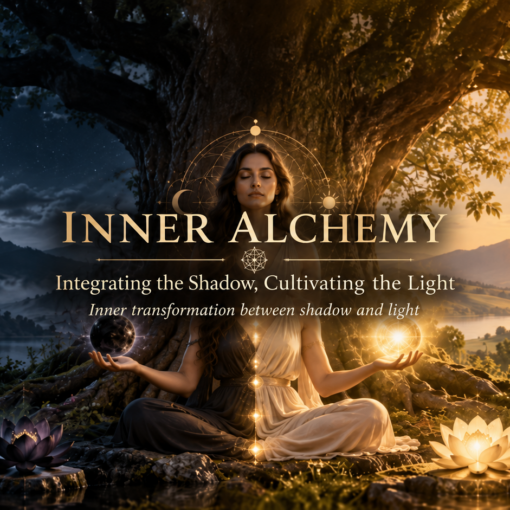
SELF KNOWLEDGE – THE AURA AND THE SUBTLE BODIES – Spiritual Traditions and Neuroscience: Understanding the Relationship Between the Energy Field, Body, Mind, and Environment
PART 1
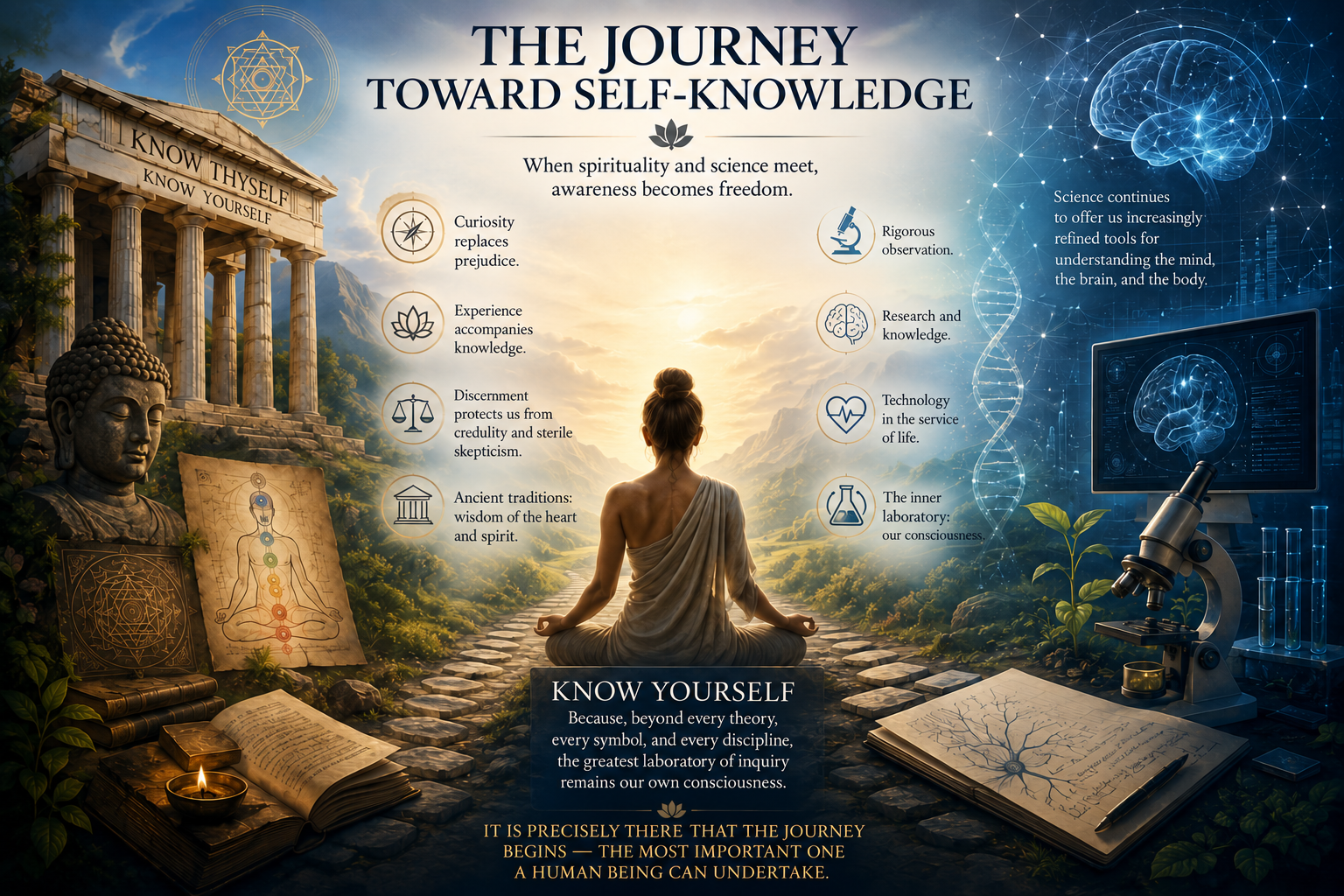
The Journey Toward Self-Knowledge
“Know thyself and you will know the universe and the gods.”
— Inscription at the Temple of Apollo at Delphi
Since the dawn of civilization, human beings have asked themselves a question destined to echo across every age, culture, and tradition:
Who am I, truly?
It is a question that appears simple only at first.
Because the moment we begin to ask it sincerely, we discover that it touches every aspect of our existence.
Are we merely a body?
Are we our mind?
Are we our thoughts, our emotions, our memories?
Or is there something deeper that animates us, sustains us, and accompanies us throughout the journey of life?
Long before the birth of modern psychology and neuroscience, men and women belonging to civilizations far removed from one another devoted their entire lives to exploring these questions.
Through meditation.
Contemplation.
Prayer.
Energy practices.
The observation of nature.
The direct experience of consciousness.
This is how what we now call wisdom traditions emerged.
Traditions whose purpose was not to construct abstract philosophical systems, but to accompany human beings through a process of inner transformation.
Their teachings were not meant to be accepted blindly.
They were invitations to practice.
Paths of experience.
Maps to guide us in the knowledge of ourselves.
It is precisely in this spirit that we will approach the concepts of the aura, subtle bodies, Prāṇa, chakras, and Akasha.
Not as dogmas to be believed.
Nor as theories that must be proven at all costs.
But as tools that, for thousands of years, have accompanied millions of people in the exploration of their inner world.
Neuroscience and contemporary research do not replace this journey.
They can, however, offer new perspectives for understanding some of the processes that accompany human experience, helping us distinguish more clearly between observation, interpretation, and lived experience.
Rationality and spirituality are not necessarily adversaries.
They can become allies.
The former invites us to observe with clarity.
The latter invites us to open ourselves to dimensions of experience that often remain unexplored.
When the two work together, the journey toward self-knowledge becomes richer, deeper, and more authentic.
Knowledge That Spans Millennia
If we look at the history of humanity, a remarkable fact emerges.
Peoples separated by thousands of miles, belonging to cultures that often had no direct contact with one another, described the human being in surprisingly similar ways.
In India, we find the concept of Prāṇa, the vital energy that permeates every form of life.
In China, we find Qi, the vital breath that flows through the organism along the meridians.
In Japan, this same force is known as Ki.
In Greek philosophy, we encounter Pneuma, the breath of life.
In the Jewish tradition, we find Ruach, the life-giving breath.
Many Indigenous cultures describe a universal life force that connects human beings with nature and the cosmos.
The names change.
The symbols change.
The practices change.
Yet one shared intuition repeatedly emerges:
life may not be merely a collection of material processes, but the expression of a deeper dimension that animates every living being.
This extraordinary convergence does not, in itself, constitute scientific proof.
It does, however, represent a cultural and spiritual heritage of immense value.
It is the result of thousands of years of inner observation, meditation, contemplative practice, and the transmission of experience.
To ignore it would mean relinquishing a fundamental part of the history of human knowledge.
What Do We Mean When We Speak of Energy?
The Italian word energia derives from the Late Latin energīa, which in turn comes from the Greek enérgeia.
In Aristotle’s philosophy, the term referred to being in actuality: the concrete realization of a possibility, as opposed to potentiality that has not yet been expressed.
In modern physics, however, energy has a precise definition. It is a quantity associated with the capacity of a system to produce change and can manifest in different forms: kinetic, thermal, chemical, electrical, electromagnetic, and so on.
When spiritual disciplines speak of vital energy, the term takes on a broader meaning.
It may refer to:
- vitality;
- quality of presence;
- inner strength;
- the movement of the breath;
- state of consciousness;
- sensations perceived within the body;
- the relationship between the individual and the environment;
- a subtle principle that sustains life.
It is therefore important not to completely overlap these two meanings.
Energy in physics is defined through measurements and mathematical models.
Spiritual energy is described through traditional maps, contemplative practices, and subjective experiences.
This does not necessarily make either language devoid of value.
It means that they observe reality from different perspectives.
Vital Energy in the Great Spiritual Traditions
In Eastern traditions, Prāṇa is not described as a mere metaphor.
It is regarded as the dynamic principle of life.
That which animates the body.
Supports the mind.
Accompanies consciousness in its experience of the world.
According to Yoga, Prāṇa flows through a network of energy channels called Nāḍīs, nourishing every level of being.
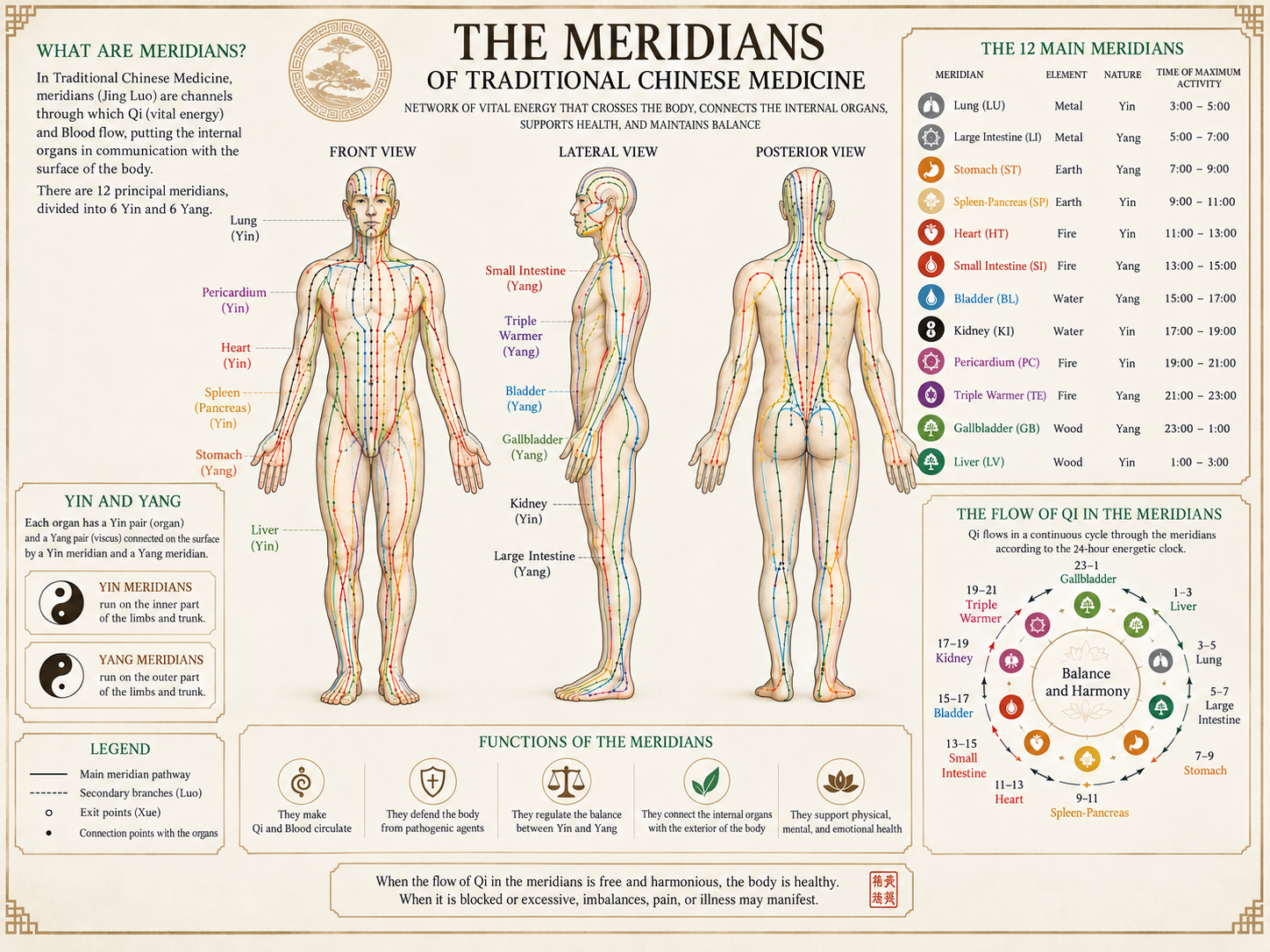
In Taoism, Qi serves a similar function, flowing along the meridians described in Traditional Chinese Medicine.
In Reiki, the practitioner learns to enter into relationship with what is called universal life energy, supporting a state of balance and harmony.
In Pranic Healing, developed by Master Choa Kok Sui on the basis of ancient energy traditions, Prāṇa is described as a force present everywhere in nature.
According to this teaching, we can absorb it primarily through three sources:
Air Prāṇa;
which is absorbed mainly through breathing.
In energy disciplines, it is not identified solely with oxygen, but with a subtler vital quality believed to be present in the atmosphere.
Solar Prāṇa;
which is associated with the light and heat of the Sun.
According to tradition, it can be absorbed through exposure to sunlight, contact with nature, and the consumption of fresh foods.
Earth Prāṇa;
which is described as a form of vital energy absorbed through contact with the ground, particularly through the soles of the feet.
This is what is referred to when speaking of the healing power of Mother Nature, and it is the basis of the modern physician’s wise advice: “Return to the earth.”
“Vitality Globules”
Some Theosophical and Pranic Healing schools describe tiny luminous points known as vitality globules, said to be especially visible in the air, in sunlight, or in natural environments.
Various practitioners report observing tiny sparkling particles or luminous movements while looking at the sky or at a bright background.
This experience can receive different interpretations.
From an energetic perspective, these points are regarded as concentrations of Prāṇa.
From a visual perspective, some luminous perceptions may also be linked to entoptic phenomena: images produced by structures within the eye, such as floaters, reflections, or cells moving through the small blood vessels of the retina.
One explanation does not necessarily have to erase the other at the level of lived experience.
The perception is real for the person experiencing it; what remains open is the way in which that experience is interpreted.
For an authoritative article, it is therefore preferable to speak of phenomena reported and interpreted by traditions, without automatically turning them either into definitive proof of subtle energy or into mere illusion.
The human being, therefore, would not be an isolated system, but an organism in continuous exchange with the surrounding environment.
Breathing.
Light.
Contact with nature.
Movement.
Emotional state.
Quality of attention.
All of these would contribute to influencing our energetic balance.
Beyond their different interpretations, these traditions share a profound message:
life is relationship.
We are constantly in dialogue with ourselves, with others, and with the world around us.
Breathing Means Much More Than Taking In Oxygen
When we hear about breathing, we immediately think of the exchange of oxygen and carbon dioxide.
Physiology describes this process with precision, and it is fundamental to the functioning of the organism.
Contemplative traditions, however, attribute an even broader meaning to the breath.
Each inhalation becomes an act of connection.
Each exhalation an act of transformation.
For this reason, disciplines such as Yoga, Qi Gong, Pranayama, and many meditative practices devote great attention to conscious breathing.
Today we know that breathing also profoundly influences the autonomic nervous system, stress regulation, heart rate, and the quality of attention.
Neuroscience describes these effects through the language of physiology.
Spiritual traditions interpret them as part of a broader process of harmonizing the whole being.
They are different perspectives.
Yet both recognize the breath as one of the most important gateways to inner transformation.
Akasha: The Space of Possibility
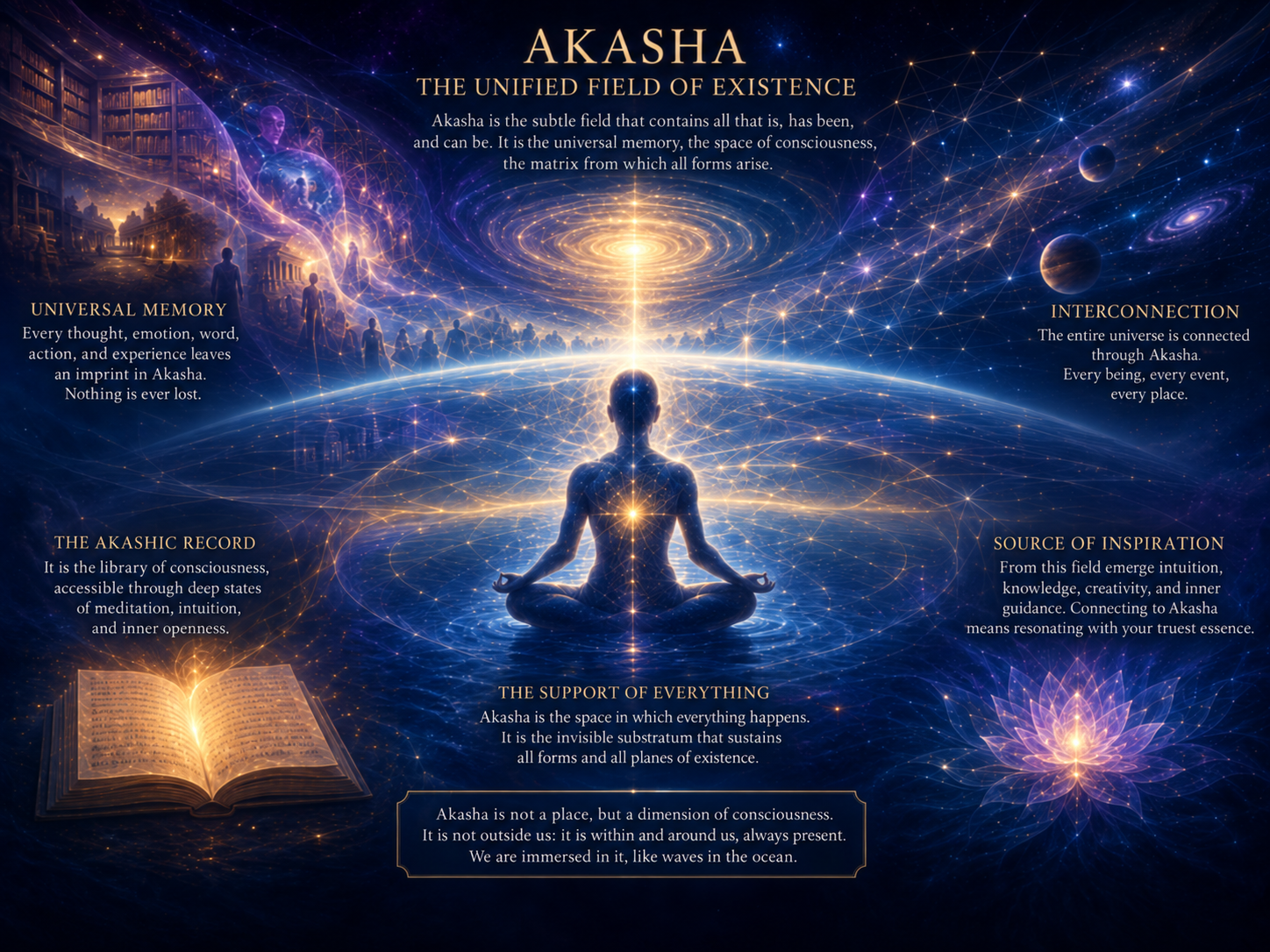
Among the most fascinating concepts found in Eastern traditions is Akasha.
In Indian philosophy, it is the subtlest of the five fundamental elements, together with water, earth, fire, and air.
It is described as the primordial space in which everything can manifest.
It is not simply emptiness.
It is the very possibility of existence.
The term derives from the Sanskrit word ākāśa, meaning “space,” “ether,” or “that which allows things to exist.”
Discoveries in contemporary physics have shown that fundamental reality is less solid, separate, and self-evident than everyday experience might suggest.
This makes a more open philosophical dialogue possible with traditions that have long described the universe as an interconnected and dynamic process.
Phenomena such as quantum field theory, entanglement, and the properties of the quantum vacuum have profoundly transformed the way we understand matter, space, and interaction.
Over the centuries, this concept has been interpreted in different ways.
For some schools, it represents the subtlest substratum of reality.
For others, it is the field in which every experience leaves a trace.
Some modern esoteric traditions even speak of the Akashic Records, understood as a symbolic memory of the soul’s experience.
Ākāśa is the principle that makes extension, relationship, and, in some interpretations, the propagation of sound possible.
For this reason, sound is often regarded in these traditions as the primary quality of Ākāśa.
The idea of creative sound appears in many cultures.
In the Vedic tradition, the syllable Om represents the primordial sound and the totality of existence.
In the Gospel of John, we find the expression:
“In the beginning was the Word.”
These teachings suggest that at the origin of manifestation there would be order, expression, meaning, and creative potential.
Sound thus becomes both a metaphor and a practice: mantras, prayers, chants, and recitations have been used for centuries to transform attention and inner states.
These interpretations belong to the heritage of spiritual traditions and cannot be regarded as established findings of scientific research.
Their value, however, does not lie solely in whether they can be experimentally demonstrated.
For centuries, they have served as inner maps through which millions of people have interpreted their path of growth, transformation, and search for meaning.
Approaching Akasha therefore means coming into contact with a broader question:
Are there levels of reality that we cannot immediately perceive through our ordinary senses, but that may be explored through deep work on awareness?
Each tradition answers this question differently.
Scientific research continues to explore the nature of consciousness and the universe with its own methods and instruments.
The spiritual path, on the other hand, invites each person to explore these possibilities through practice, meditation, and personal experience.
It is not about choosing between science and spirituality.
It is about recognizing that both arise from the same human aspiration:
to understand reality more deeply and to understand ourselves more deeply.
Is Everything Energy?
The phrase “everything is energy” has become very common in contemporary spirituality.
It contains a valid intuition, but it needs to be understood precisely.
From a physical perspective, matter and energy are deeply connected. Matter is made up of systems described through particles, fields, interactions, and energetic quantities.
This, however, does not mean that every spiritual use of the word energy automatically corresponds to a measurable physical quantity.
When we say that a place has heavy energy, that a person radiates calmness, or that a thought carries a certain vibration, we are often describing a lived quality.
We may be perceiving:
- tone of voice;
- rhythm of movement;
- posture;
- facial expressions;
- level of tension;
- quality of attention;
- our own bodily state in the presence of another person.
Energetic language gathers these different signals into a unified perception.
Saying that we perceive a person’s energy may therefore describe a real experience, even when we are not yet able to distinguish all of its physiological, relational, intuitive, and, according to spiritual traditions, subtle components.
Does Everything Vibrate?
The statement “everything vibrates” can also be interpreted on several levels.
Matter does indeed involve oscillations, frequencies, molecular movements, waves, and fields.
Sound is a mechanical vibration.
Light has wave-like properties.
Atoms and molecules display specific energetic states and modes of motion.
However, the density of an object does not simply depend on whether it has a “low” or “high” vibration in the spiritual sense.
When traditions speak of higher or heavier vibration, they generally use the term to describe qualities of consciousness.
Compassion, clarity, and openness are associated with a higher vibration.
Fear, hostility, and closure are associated with a denser vibration.
This is symbolic and experiential language, not simply a measurement in hertz.
We can therefore preserve this language while clarifying the level on which it is being used.
What We Do Not Perceive May Still Exist
Human beings perceive only a small portion of the stimuli present in the environment.
We cannot hear the ultrasonic frequencies perceived by certain animal species.
We cannot directly see infrared or ultraviolet radiation.
We cannot observe atoms, bacteria, or many microscopic structures with the naked eye.
This reminds us of an important principle: the limits of our senses are not the same as the limits of reality.
This consideration does not, by itself, constitute proof of the aura or subtle bodies.
It does, however, invite us to maintain an epistemologically open position.
Throughout history, many phenomena became observable only after the development of appropriate instruments and methods.
It is therefore reasonable to avoid both automatic belief and automatic rejection.
Between these two extremes lies the space of inquiry.
An Invitation to the Inner Journey
Every authentic spiritual path begins with a simple act.
Stopping.
Observing.
Listening.
Breathing.
Becoming present.
The great traditions do not ask us to abandon critical thinking.
Rather, they invite us to broaden the way we know and understand.
Alongside reason, there are intuition, contemplation, direct experience, and inner transformation.
These dimensions do not exclude one another.
They can be integrated.
And it is precisely within this dialogue between ancient wisdom, personal experience, and contemporary research that the journey we will explore in the following sections begins.
Because learning about the aura, subtle bodies, or chakras does not mean accumulating new information.
It means learning, step by step, to know ourselves more deeply.
Conclusion of Part 1
To speak of vital energy is to enter a territory in which experience, spirituality, philosophy, and research meet.
Ancient traditions have used the language of Prāṇa, Qi, Ki, and Akasha to describe the continuity between the individual and the universe.
Contemporary science studies fields, signals, energetic processes, biological regulation, and interaction with the environment.
These languages should not be artificially merged, but neither should they be separated so completely that all dialogue becomes impossible.
What one tradition calls vital energy may include different dimensions:
- physiological processes;
- bodily experience;
- emotional states;
- attention;
- relationships;
- intuitive perception;
- and, according to spiritual schools, subtler components of being.
Self-knowledge begins precisely here.
In recognizing that we are matter, but not only matter.
Body, but not only body.
Individual experience, yet always immersed in a wider network of relationships, life, and meaning.
In Part 2, we will move directly into the structure of the aura and compare the model of the etheric, astral, mental, causal, buddhic, and atmic bodies with the five kośas of the yogic tradition.
PART 2
The Aura and the Subtle Bodies – A Map for Understanding the Depth of the Human Being
If spiritual traditions around the world share the idea of a vital force that animates every living being, a new question naturally arises.
How does this energy manifest within the human being?
To answer this question, many wisdom traditions developed a remarkably elaborate vision of the person.
According to these traditions, what we call the “self” does not coincide solely with the physical body.
The human being would be a multidimensional reality.
A set of different, deeply interconnected levels through which consciousness experiences life.
From this perspective, the body represents only the most visible level of a much broader reality.
Alongside it, subtler dimensions are said to exist, often described as fields of energy, consciousness, or information, continuously participating in our physical, emotional, mental, and spiritual balance.
Among these concepts, one of the best known is the Aura.
What Is the Aura? – From Universal Energy to the Individual Field
According to many spiritual traditions, universal vital energy becomes individualized within each living being, forming a characteristic field.
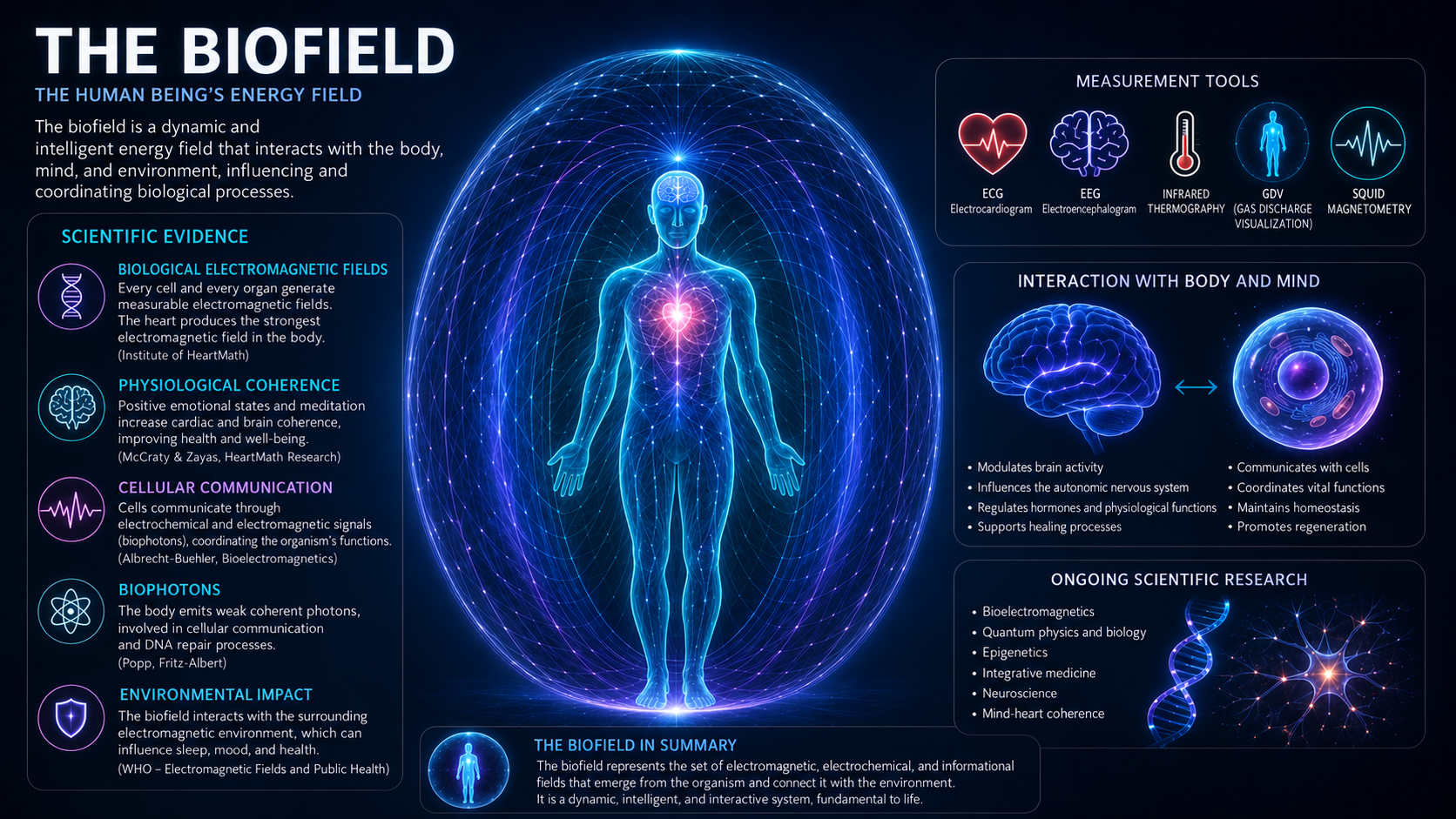
This field is called the aura, the energy body, or, in some contemporary research, the biofield.
The term biofield has been used to bring together different hypotheses and phenomena concerning the regulatory, communicative, and energetic interactions of living organisms. Some researchers consider it an emerging field that is still being defined, intended to explore aspects of biological regulation that are not always fully explained by simpler models.
However, at least three levels need to be distinguished.
Measurable Biological Fields
The body produces electrical, magnetic, thermal, and luminous activity.
The heart generates electrical signals that can be detected through an electrocardiogram.
The brain produces electrical activity measurable through an electroencephalogram.
Cells communicate through chemical and electrical signals.
These phenomena belong to documented physiology.
The Biofield as an Integrative Hypothesis
Some researchers use the term biofield to refer to a broader set of processes through which the organism coordinates its activity and interacts with the environment.
The literature in this area is still heterogeneous, and no single model is universally accepted.
Research nevertheless continues to explore the possibility that living systems may be understood not merely as the sum of their parts, but as dynamic and integrated networks.
It is important to clarify that the concept of the biofield does not automatically correspond to the aura described by spiritual traditions.
The biofield represents an evolving area of research in which biology, integrative medicine, biophysics, and studies of energy-based therapies converge.
The aura, by contrast, originated as a contemplative and experiential concept.
The two models are not identical.
They may, however, be regarded as different attempts to understand the complexity of the human being.
Scientific research continues to investigate how complex biological systems coordinate themselves through networks of electrical, magnetic, biochemical, and mechanical signals.
Spiritual traditions describe the same complexity through the language of subtle bodies and Prāṇa.
Although these models cannot simply be superimposed on one another, the dialogue between them represents one of the most interesting areas of contemporary inquiry.
Returning to the esoteric description of the Aura, we know that the word Aura derives from the Greek aura, meaning “breath,” “breeze,” or “emanation.”
In the language of spiritual traditions, the aura is described as a subtle, luminous, and informational field that interpenetrates and surrounds the body and reflects the vitality, emotions, thoughts, character, and spiritual development of the individual.
According to wisdom traditions, therefore, the aura is the dynamic manifestation of a person’s overall state:
Body, through the etheric double;
Emotions;
Thoughts;
Vitality;
Awareness.
Every aspect of our experience would continuously contribute to the quality of this field.
For this reason, in energy practices, the aura becomes a tool for self-knowledge.
Learning to listen to our inner state means, first of all, learning to recognize what is happening within us.
Many traditions describe this sensitivity as the natural result of consistent practice.
Not as an extraordinary power reserved for a select few.
But as a capacity that can develop through presence, meditation, discipline, and personal transformation.
The goal is not to “see the aura.”
The goal is to become increasingly self-aware.
We know that the body is never truly isolated.
It continuously exchanges matter, energy, and information with the environment.
We breathe.
We absorb light.
We receive sounds.
We come into contact with surfaces, temperatures, and substances.
We perceive other people’s expressions.
We unconsciously modify our bodily rhythms in response to relationships.
Environments can calm us, activate us, exhaust us, or make us feel protected.
Some of these processes can be explained through physiology, perception, learning, and the nervous system.
Energy disciplines add another interpretive layer: every encounter would also involve an exchange between subtle fields.
From this perspective, the aura is not a rigid barrier.
It is a living, permeable, and dynamic boundary.
It absorbs.
It transmits.
It expands.
It contracts.
It responds to health, emotions, thoughts, environments, and relationships.
According to these traditions, every experience leaves a trace in our energetic field.
Likewise, our way of being would influence the way we relate to the world.
The Nervous System: The Great Interpreter of Experience
Every experience we have inevitably passes through the nervous system.
Every sound.
Every image.
Every emotion.
Every thought.
Every memory.
Every bodily sensation.
The brain does not simply record what happens.
It interprets it.
It compares it with previous experiences.
It anticipates its meaning.
It continuously constructs a representation of reality.
In recent decades, neuroscience has developed models such as predictive processing and the Free Energy Principle, according to which the brain does not passively wait for events but constantly generates predictions about the world, updating them through comparison with experience.
From this perspective, perception is not simply a photograph of reality.
It is a dynamic construction.
This means that what we experience always arises from the encounter between what happens outside us and the way our organism interprets it.
It is interesting to observe how many contemplative traditions have expressed, in different languages, a similar intuition:
the reality we experience also depends on the state of consciousness through which we observe it.
The Aura in the Great Spiritual Traditions
Although they use different languages and conceptual frameworks, many traditions describe a field that connects the human being with the surrounding environment.
In Yoga, it is associated with the flow of Prāṇa.
In Pranic Healing, it constitutes the primary object of observation and energetic work.
In Reiki, it is considered an integral part of the person’s rebalancing process.
In Theosophy, it is described as a set of different vibrational levels that reflect the evolutionary journey of consciousness.
Christianity too, although it uses a different language, often depicts saints and spiritual figures surrounded by a luminous halo.
This representation expresses the idea that profound inner transformation can also be symbolically manifested as light.
It is interesting to observe how similar images appear in cultures that are very distant from one another. This shows how, over the centuries, humanity has perceived that the human being seems to express something that goes beyond the purely material dimension.
This description prepares the transition to the second part of the article, in which we will explore more precisely what is meant by the aura, how the subtle bodies are described, and why different traditions propose maps of the human being that are not always identical.
A Map, Not a Dogma
One of the most fascinating aspects of contemplative traditions is that they rarely claim to describe reality in a definitive way.
Rather, they offer maps.
A map helps us find our way.
It does not replace the territory.
In the same way, the concepts of the aura, subtle bodies, and energy centers did not arise merely to satisfy theoretical curiosity.
They emerged to accompany a path of transformation.
When a yogi speaks of Prāṇa.
When a Reiki practitioner speaks of energy.
When a meditation teacher speaks of presence.
When a Pranic Healing instructor describes the energy field.
All of them are trying, through different languages, to point in a direction.
To know ourselves more deeply.
It is important to remember this principle throughout the entire reading.
Because the greatest risk is not believing too much.
It is stopping at concepts without living the experience.
The Subtle Bodies: A Geography of Being
To describe the complexity of the human being, many traditions have developed the concept of subtle bodies.
According to this view, our experience would not take place exclusively through the physical body.
Different levels of consciousness would exist, each with specific characteristics and functions.
These descriptions are not identical in every school.
Each tradition has developed its own language.
And yet, a remarkable convergence emerges:
the human being is far greater than the material dimension alone.
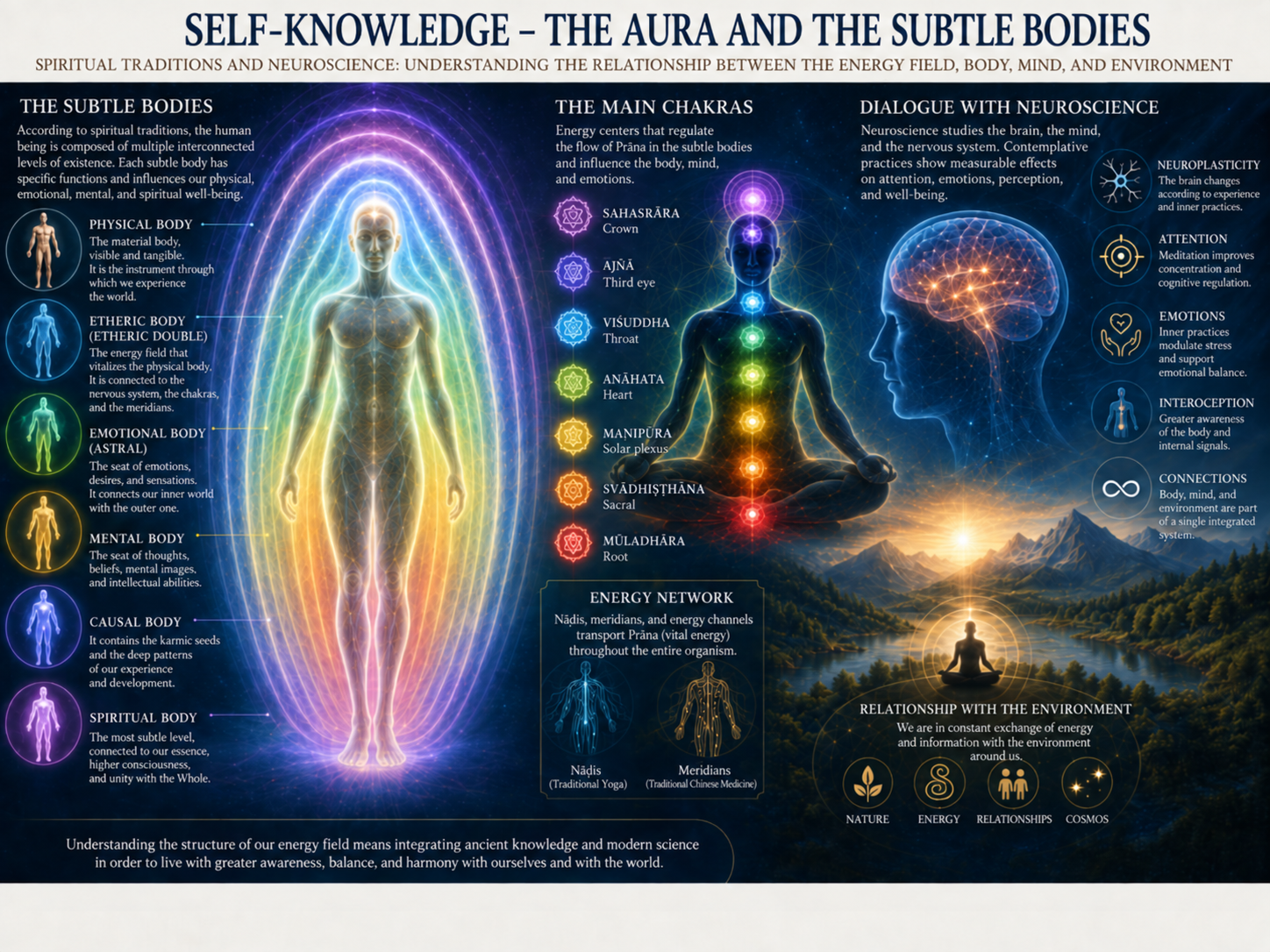
Among the oldest models is that of the five Kośas, described in the Taittirīya Upaniṣad.
According to this teaching, the human being is surrounded by five concentric “sheaths” representing different levels of experience.
1. Annamaya Kośa
The Physical Body
This is the body made of matter.
The one we can see, touch, and study through medicine and biology.
It is the instrument through which we experience the sensory world.
Taking care of it means respecting the foundation of our earthly experience.
2. Prāṇamaya Kośa
The Energy Body
This is the level through which, according to Yoga, Prāṇa flows.
Through this sheath, life animates the physical body.
Breathing practices, Pranayama, Qi Gong, and many energy disciplines are specifically aimed at harmonizing this level of being.
3. Manomaya Kośa
The Mental-Emotional Body
This is where thoughts, emotions, inner images, and psychological reactions take shape.
It is the level at which we experience desires, fears, memories, and conflicts.
Many meditative practices begin precisely by learning to observe this inner space without completely identifying with it.
4. Vijñānamaya Kośa
The Wisdom Body
It is associated with the capacity for discernment.
With intuition.
With deep understanding.
With the ability to observe the mind without being carried away by it.
The great traditions describe this level as the place where a more authentic knowledge of oneself begins.
5. Ānandamaya Kośa
The Bliss Body
This is the subtlest level described in the Upaniṣads.
It does not represent a simple pleasant emotion.
It indicates a state of profound unity, peace, and wholeness that many contemplative traditions describe as a natural expression of consciousness when the mind becomes silent.
Other Models of the Subtle Bodies
Over the centuries, other descriptive systems have been proposed.
In the nineteenth and twentieth centuries, Theosophy developed a highly detailed description of the so-called subtle bodies.
This classification profoundly influenced many modern esoteric schools, including numerous systems of energy healing.
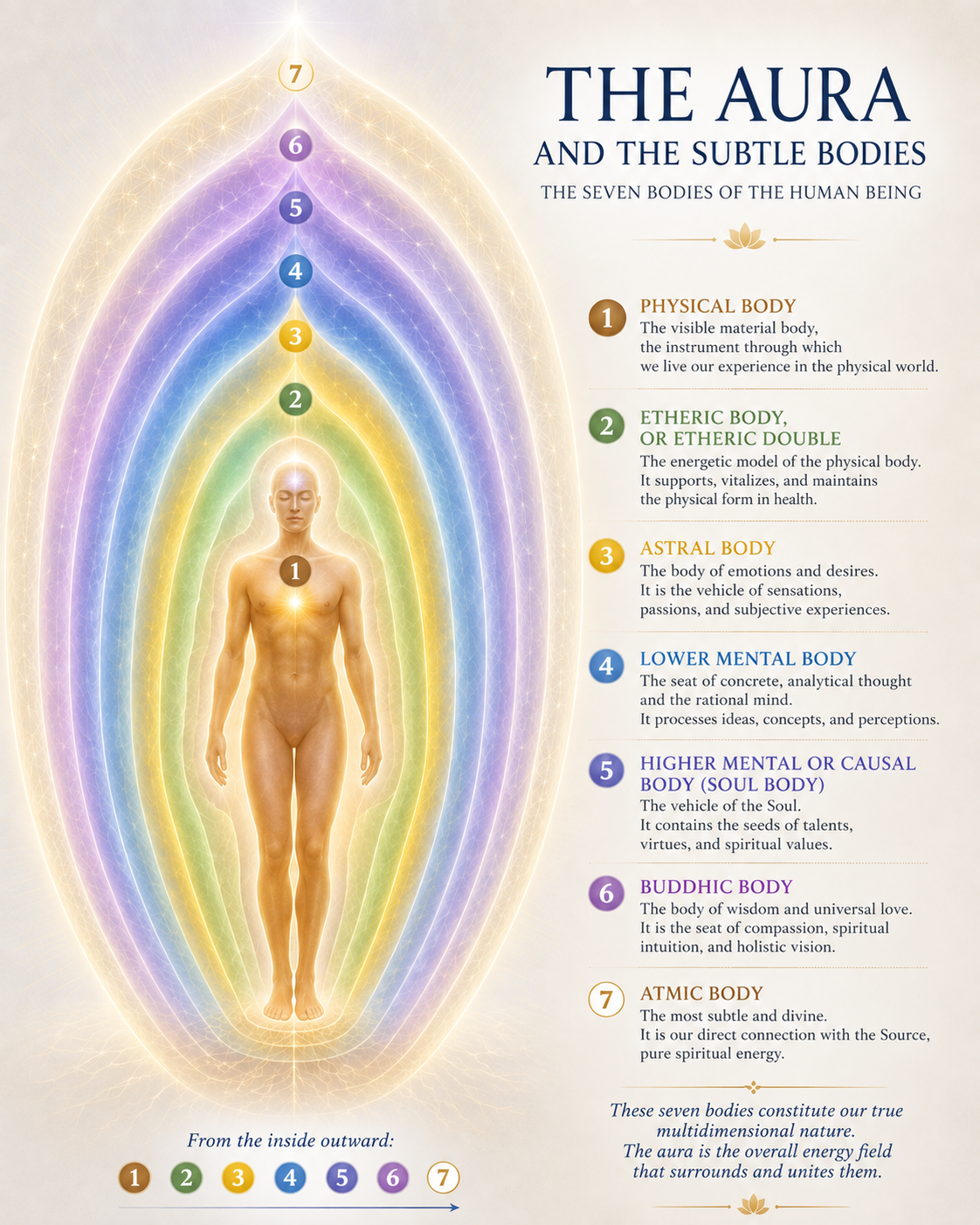
The model generally includes:
- physical body;
- etheric body, or etheric double;
- astral body;
- lower mental body;
- higher mental or causal body;
- buddhic body;
- atmic body.
Although it uses terminology different from that of the Upaniṣads, many conceptual affinities can be observed.
Both models describe a gradual movement from matter toward increasingly refined levels of consciousness.
The Etheric Body (or Etheric Double)
According to Theosophy and Pranic Healing, the etheric body represents the energetic level closest to the physical body.
It is described as a matrix through which Prāṇa is absorbed, distributed, and used by the organism.
Within this model, the etheric body would include:
- the chakras;
- the nāḍīs;
- the energy meridians;
- the so-called health rays.
According to these traditions, the proper balance of the etheric body would support the vitality of the entire organism.
Contemporary medicine does not describe an etheric body as a distinct anatomical structure. It does, however, recognize that the regulation of the organism depends on extremely complex networks of electrical, biochemical, endocrine, immune, and nervous communication.
Although these are different models, both emphasize that the human body functions as a deeply integrated system.
The Astral Body
The astral body is generally associated with the emotional dimension.
According to energy disciplines, emotions such as joy, fear, love, anger, sadness, and compassion would continuously modify the quality of this level.
Many clairvoyants describe the astral body through different colors, forms, and movements.
Naturally, such descriptions belong to the subjective experience of practitioners and do not constitute a universally verifiable language.
What appears particularly interesting is that contemporary psychology also recognizes how deeply emotional states influence posture, facial expressions, tone of voice, breathing, attention, and behavior.
Energy traditions interpret these changes through the language of the astral body.
Neuroscience describes them through the functioning of the nervous system.
Once again, the maps change.
The human experience remains the same.
The Lower Mental Body
Many schools distinguish the mental body into two aspects.
A lower mental body, associated with reasoning, memory, conditioning, and the construction of personal identity.
And a higher mental or causal body, oriented toward intuition, creativity, discernment, and deep understanding.
The causal body is associated with a more stable spiritual identity, the seeds of experience, and the deeper causes of inner evolution.
This distinction presents interesting parallels with many contemplative traditions.
Mindfulness also teaches that we can observe thoughts without completely identifying with them.
The difference lies in the language being used.
Energy disciplines speak of different levels of the mental body.
Neuroscience describes brain networks, cognitive processes, and metacognition.
Both approaches, however, recognize the importance of developing a mind that is less bound by automatic patterns.
The Buddhic and Atmic Bodies
Beyond the mental level, many traditions describe increasingly profound levels of consciousness.
The buddhic body represents the dimension of universal love, compassion, and unity.
The atmic body is ultimately described as the highest level of being, in which consciousness recognizes its essential nature and its union with the Divine Principle.
These descriptions belong to contemplative language.
They do not claim to measure a physical reality.
Rather, they attempt to point toward inner experiences that many mystics, belonging to different cultures, have described using remarkably similar words.
Other esoteric schools also propose their own models.
These differences should not surprise us.
Each tradition observes the human being from a particular perspective.
Just as a mountain looks different when viewed from different sides.
The landscape changes.
The mountain remains the same.
Why Do Different Maps Exist?
Many people wonder which classification is the “correct” one.
Perhaps that is not the most useful question.
Contemplative traditions did not arise to construct a universal anatomy of the invisible.
They arose to help human beings transform themselves.
Spiritual maps serve a function similar to maps used in science.
They are models.
Tools for orientation.
Attempts to describe an extremely complex reality.
No map can ever fully exhaust the territory.
And it is precisely this awareness that allows us to approach every tradition with openness, respect, and discernment.
For this reason, the deepest value of the aura does not lie in seeing colors or classifying energetic levels.
It lies in learning to recognize that what happens in the body, emotions, mind, and spiritual dimension is intimately connected.
And it is precisely from this integrated vision that the true path of self-knowledge begins.
Experience Before Interpretation
In the contemporary world, it is easy to fall into two opposite extremes.
On one side are those who reject any inner experience because it is not immediately measurable.
On the other are those who interpret every sensation as evidence of extraordinary phenomena.
The great contemplative traditions invite us toward a third way.
Practice.
Observe.
Be patient.
Do not rush to give a name to every experience.
Over time, through meditation, presence, and inner work, sensitivity naturally grows.
Not in order to reinforce beliefs.
But to develop an increasingly profound knowledge of ourselves.
Because the true purpose of the aura and subtle bodies is not to convince us that an invisible world exists.
It is to help us become more present, more aware, and more authentically alive.
In the next section, we will explore one of the best-known maps of the Eastern traditions: the chakras, the Nāḍīs, and the energy meridians, understanding how these ancient descriptions have accompanied the journey of millions of spiritual seekers for thousands of years.
PART 3
Chakras, Nāḍīs, and Meridians – How Vital Energy Becomes Experience and the Path of Inner Transformation
If the subtle bodies represent a map of the human being, a new question naturally arises.
How does vital energy move within this map?
It is precisely in response to this question that, over the course of millennia, the great contemplative traditions described a network of energy channels, centers of consciousness, and pathways through which life would express itself within the human being.
These descriptions did not arise from anatomical observation of the body.
They arose from direct experience.
In countries such as India, China, Tibet, Japan, and Egypt, generations of meditators, yogis, ascetics, healers, and spiritual seekers devoted their lives to exploring consciousness.
The maps they left us are the result of this long journey: an energetic anatomy that does not replace physiology, does not compete with medicine, but simply speaks about another level of human experience.
Understanding them means coming into contact with one of humanity’s oldest traditions of knowledge and leaving space for alternative answers to another set of questions:
How do the subtle bodies communicate with one another?
How can a thought affect the body?
Why does a strong emotion accelerate the heartbeat?
How can a meditative practice produce a sense of calm that simultaneously involves the mind, breathing, and posture?
Contemplative traditions answer by introducing a fundamental element of their energetic anatomy:
the network through which Prāṇa is distributed throughout the entire human being.
This network is primarily composed of:
- Nāḍīs
- Chakras
- Energy meridians (in the Chinese tradition)
Together, they form a dynamic map of the circulation of vital force.
The Nāḍīs – The Channels of Vital Force
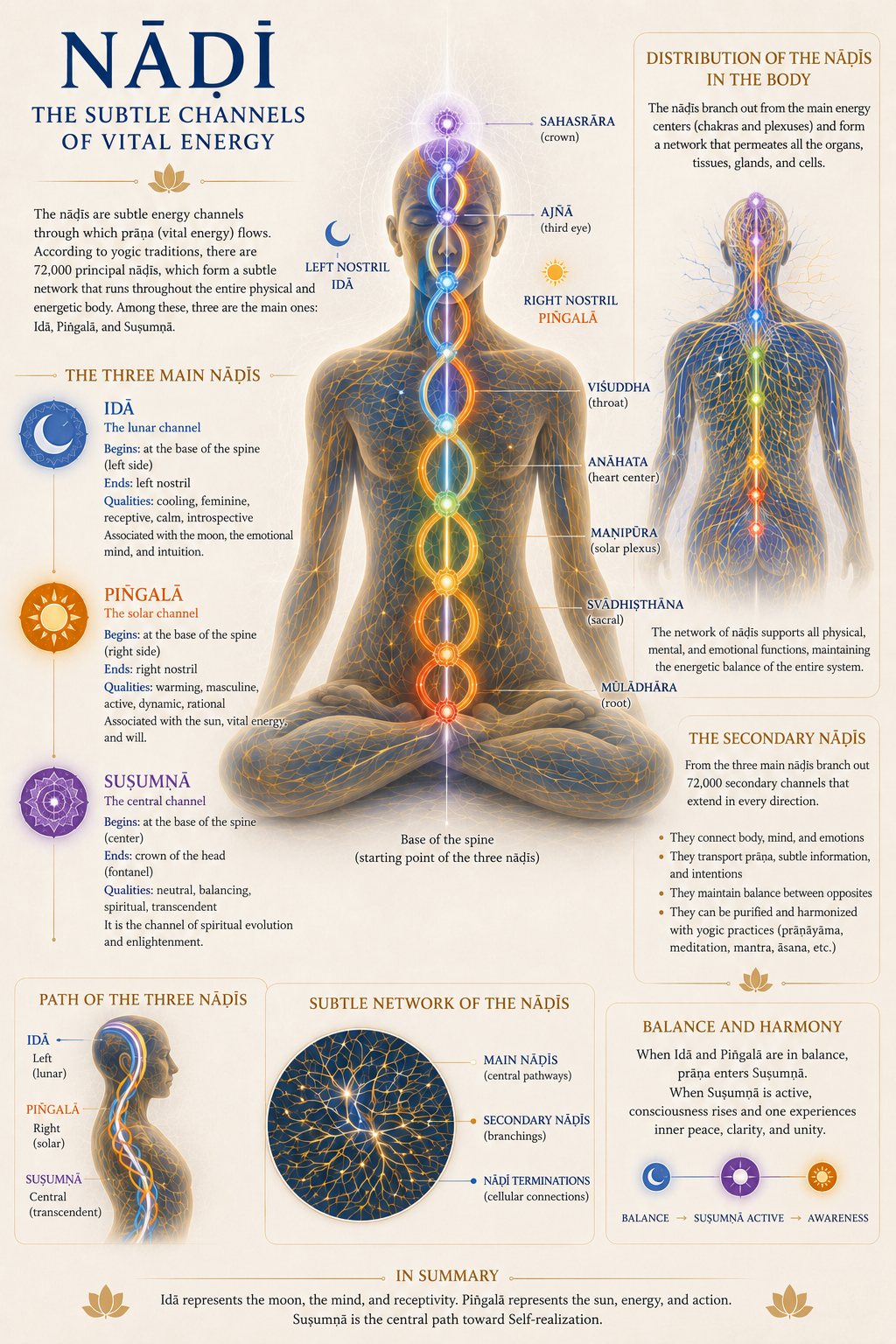
In the yogic tradition, the Nāḍīs are described as the channels through which Prāṇa flows.
The Sanskrit word nāḍī literally means:
flow
current
channel
Classical texts speak of 72,000 Nāḍīs, although some describe different numbers.
This figure should not be interpreted as an anatomical measurement.
The number primarily carries a symbolic meaning.
It expresses the idea that every part of the human being is permeated by life.
Among all the Nāḍīs, three play a central role.
Iḍā
Associated with the Moon.
With receptivity.
With intuition.
With calm.
With the introspective dimension.
Traditionally, it is represented as rising along the left side of the body.
Piṅgalā
Associated with the Sun.
With action.
With vitality.
With dynamism.
With will.
Symbolically, it rises along the right side.
Suṣumṇā
It is the central channel.
According to Yoga, it represents the path through which consciousness can progressively rise.
When the energies of Iḍā and Piṅgalā come into balance, Prāṇa can flow through Suṣumṇā.
Many traditions regard this moment as the beginning of the true spiritual path.
More than a physical phenomenon, it represents a state of integration.
The mind becomes more stable.
The body more relaxed.
Attention clearer.
Presence deeper.
Se questo contenuto ti è utile, puoi sostenerlo con una donazione libera 🙏
The Chakras – The Great Centers of Energetic Organization
The Sanskrit word Chakra means:
wheel or disk.
The term evokes the image of a vortex.
A point where energy converges, becomes organized, and is redistributed.
In yogic traditions, the chakras are not simply “wheels of energy.”
They are symbolic places where body, emotions, mind, and consciousness meet.
Each chakra simultaneously represents:
- a vital function;
- a psychological dimension;
- an evolutionary theme;
- a spiritual quality.
For this reason, working with a chakra does not simply mean rebalancing a presumed energy center.
It means transforming the way we live that particular area of human experience.
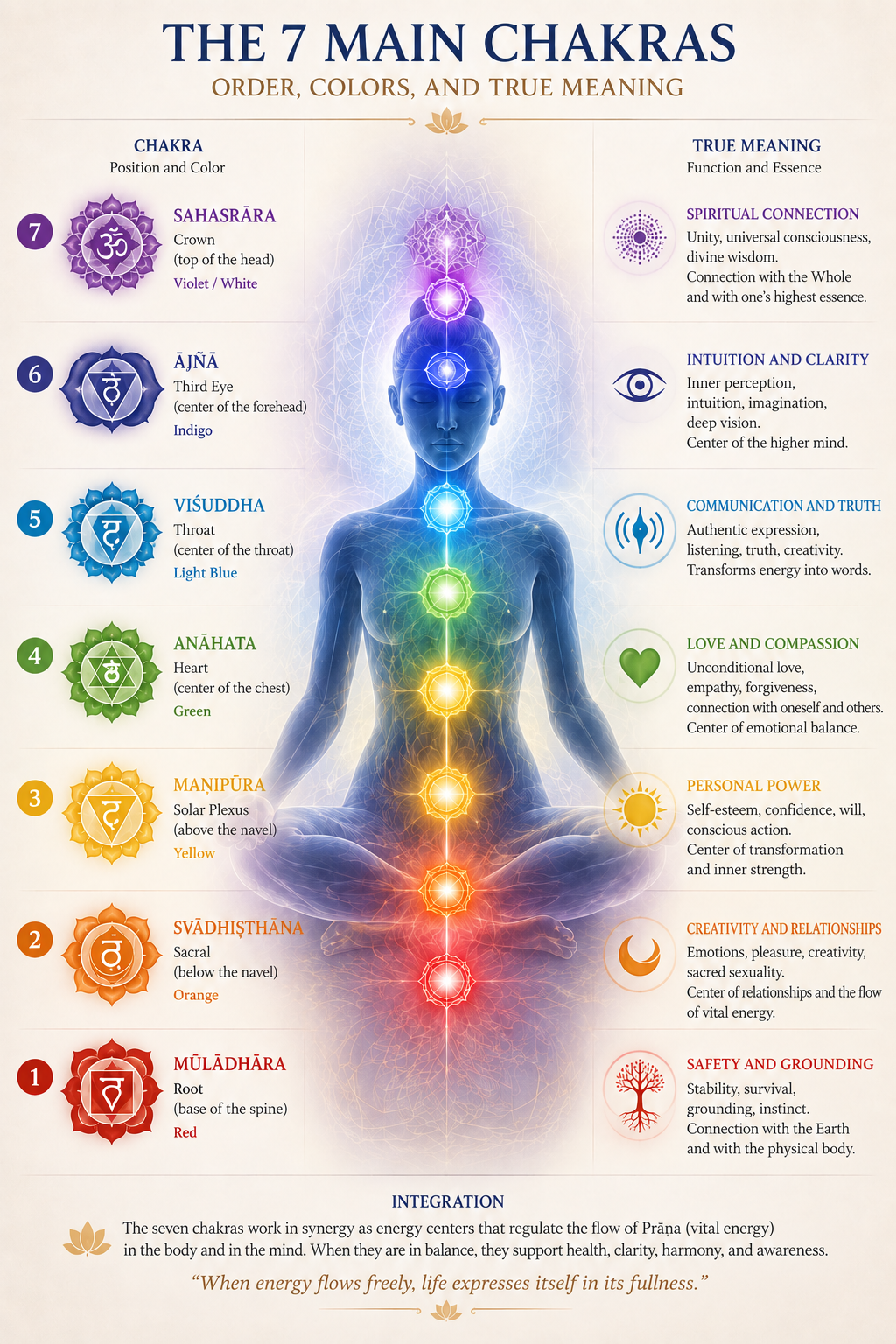
The Seven Main Chakras
Different schools describe many chakras.
The best-known model includes seven main centers.
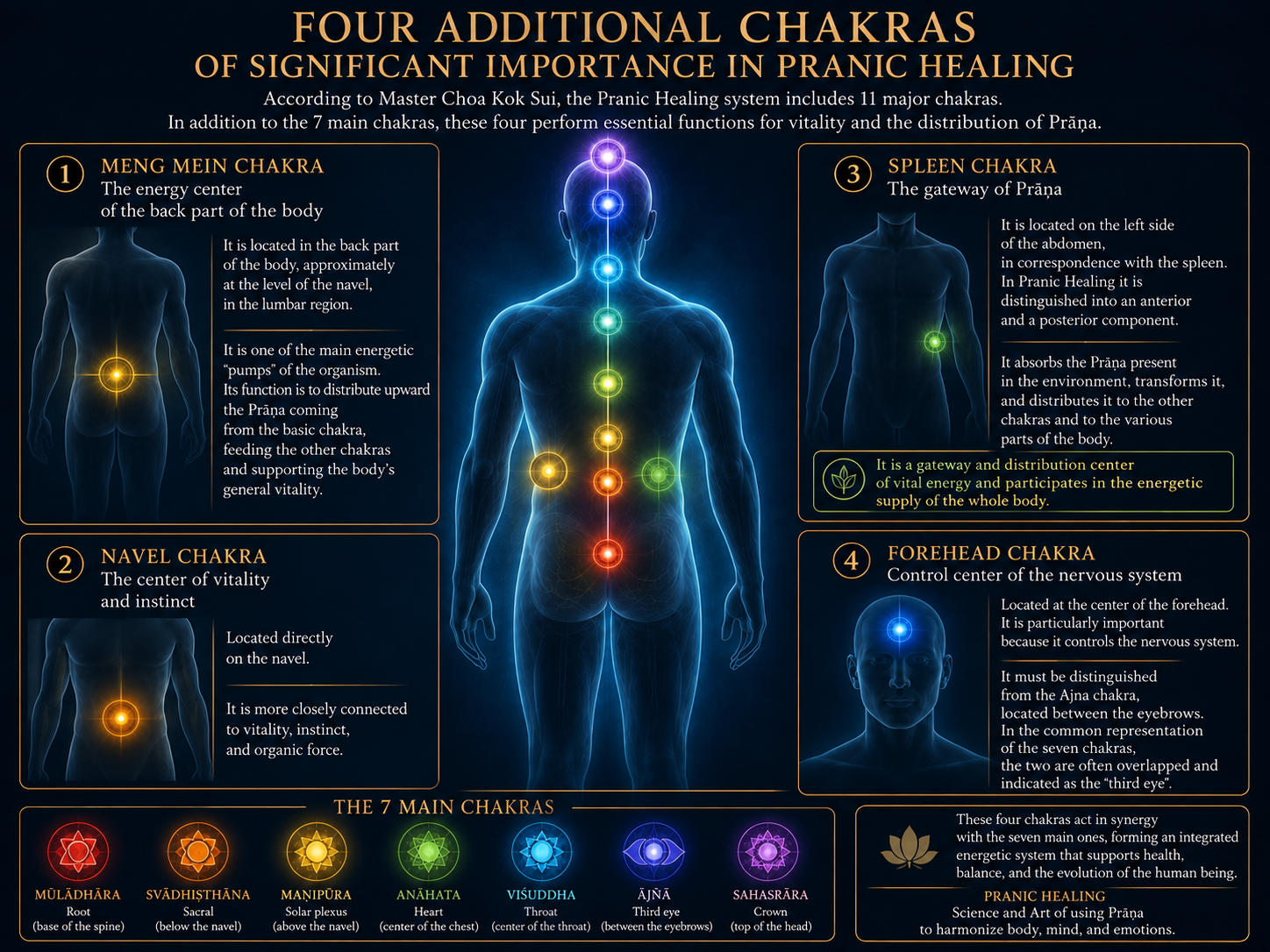
In Pranic Healing, as in other esoteric disciplines, the chakras are not regarded as mere spiritual symbols.
They are described as energy centers that absorb, distribute, and regulate Prāṇa within the organism.
Each chakra is connected with specific regions of the body, certain endocrine glands, particular organs, and aspects of our emotional and psychological life.
According to this model, when a chakra functions harmoniously, it contributes not only to the well-being of the area with which it is associated but also to overall well-being; when energetic imbalances occur, these alterations may be reflected on both the psychological and physical levels.
Mūlādhāra – The Root Chakra
In Pranic Healing, it is primarily associated with the adrenal glands, which are responsible for producing hormones that are essential to the stress response, as well as with the legs, bones, muscles, blood, and the lower part of the spine.
From a psychological perspective, it governs the sense of security, emotional stability, the ability to face life’s difficulties, and our relationship with the material world.
When harmonious, it supports confidence, inner strength, perseverance, and the ability to face challenges.
When imbalanced, fear, insecurity, a sense of vulnerability, an excessive need for control, or difficulty feeling “grounded” may arise.
More generally, therefore, it represents our relationship with safety.
The body.
Stability.
Belonging.
In everyday life, it manifests as the ability to feel present, supported, and rooted.
Every authentic spiritual path begins here.
Before rising, it is necessary to put down roots.
Svādhiṣṭhāna – The Sacral Plexus Chakra (or Sex Chakra)
It is the center of creative energy and vitality.
According to Pranic Healing, it is mainly associated with the gonads (ovaries and testicles), the reproductive organs, the bladder, and part of the lower abdomen.
Psychologically, it governs creativity, pleasure, sexuality, the ability to experience balanced relationships, and the expression of emotions.
When harmonious, it supports spontaneity, openness, enthusiasm, and a healthy ability to form bonds.
When imbalanced, emotional dependency, rigidity, relationship difficulties, feelings of guilt, or compulsive pleasure-seeking may arise.
More generally, it is connected with the emotional world.
Physical creativity.
Pleasure.
The ability to enter into relationship.
Openness to experience.
Here we learn to let life flow without being overwhelmed by it.
Maṇipūra – The Solar Plexus Chakra
In Pranic Healing, it is considered one of the most important chakras and is distinguished into a front and a back aspect.
It is associated with the pancreas, liver, stomach, gallbladder, intestines, spleen, and much of the digestive system.
It is the center of personal will, identity, self-esteem, and emotional management.
According to the energetic model of Pranic Healing, many intense emotions are processed through this chakra.
When balanced, it supports determination, emotional balance, self-confidence, and decision-making ability.
When congested or depleted, anger, irritability, anxiety, insecurity, a need for approval, feelings of inferiority, or difficulty managing stress may arise.
Traditionally, it is associated with fire.
With will.
With autonomy.
With transformation.
With responsibility.
With intellect.
With the ability to act with balance through self-mastery.
It is the place of strength and personal power.
Anāhata – The Heart Chakra
In Pranic Healing, the heart chakra is distinguished into the front heart chakra and the back heart chakra.
It is mainly associated with the thymus, the heart, the lungs, and the immune system.
From a psychological perspective, it represents love, compassion, kindness, forgiveness, and the ability to create authentic connections.
When it functions harmoniously, it supports empathy, emotional balance, and openness toward others.
When imbalanced, emotional withdrawal, resentment, excessive attachment, difficulty forgiving, or difficulty receiving love may arise.
More generally, it is the center of love.
Compassion.
Forgiveness.
Integration.
Many traditions consider it the bridge between the lower chakras, which are more closely connected with personal experience, and the higher chakras, which are oriented toward the spiritual dimension.
Viśuddha – The Throat Chakra
It is primarily associated with the thyroid and parathyroid glands, as well as with the throat, larynx, vocal cords, mouth, and part of the respiratory system.
Psychologically, it governs communication, authenticity, and the ability to express one’s inner world.
When harmonious, it supports clarity, sincerity, listening, and communication skills.
When imbalanced, shyness, difficulty expressing emotions, fear of judgment, or aggressive or excessively impulsive communication may arise.
More generally, it is connected with communication.
Truth.
Authentic expression.
The ability to give voice to who we are.
Speaking authentically is a form of spiritual practice.
Ājñā – The Third Eye Chakra
In Pranic Healing, it is considered one of the main control chakras.
It is associated with the pituitary gland, the eyes, the brain, and, indirectly, with regulation of the entire endocrine system.
From a psychological perspective, it is associated with intelligence, discernment, concentration, intuition, and the ability to understand reality clearly.
When harmonious, it supports mental clarity, decision-making ability, and an overall perspective.
When imbalanced, confusion, mental rigidity, excessive rationalization, or difficulty concentrating may arise.
More generally, it is associated with intuition and inner vision.
Discernment.
Clarity.
The ability to see the bigger picture.
The ability to observe without being completely identified with what is happening.
Here, the mind begins to become an instrument of consciousness rather than its only protagonist.
Sahasrāra – The Crown Chakra
It is the spiritual center par excellence.
In the Pranic Healing model, it is primarily associated with the pineal gland and, together with the forehead chakra, with regulation of the entire energy system.
It represents connection with the spiritual dimension, the sense of unity, the search for meaning, and the perception of belonging to something greater.
When harmonious, it supports serenity, inspiration, spiritual openness, and a sense of profound connection with life.
When imbalanced, a sense of emptiness, loss of meaning, spiritual closure, or an unbalanced spiritual search disconnected from everyday reality may arise.
More generally, it is the thousand-petaled lotus.
It represents the highest level of consciousness, unified consciousness.
The transcendence of the ego.
Connection with the Principle.
It is considered the symbol of openness to the spiritual dimension.
The traditions remind us, however, that this does not represent a definitive endpoint.
Rather, it is a continuous deepening of our relationship with life.
An Integrated View of the Person
One of the most interesting aspects of the Pranic Healing model is that it invites us to consider the human being as a deeply integrated system. Body, emotions, mind, and spiritual dimension are not seen as separate elements, but as different aspects of the same reality in continuous dialogue.
According to this perspective, each chakra simultaneously participates in the regulation of energy, the functioning of specific areas of the organism, and the way we experience our inner life.
Although it belongs to a spiritual tradition rather than to a scientific model validated by contemporary medicine, this map continues to be used by millions of practitioners around the world as a tool for observation, personal growth, and energy practice.